Excel vs App for Small Business Hisab in Nepal · Aafno Hisab
Business
Excel vs an App for Small Business Hisab in Nepal
8 min read · Published 12 Sept 2026 (27 Bhadra 2083)
Almost every small business in Nepal is somewhere on the same path. It starts in a notebook. Someone's son or daughter sets up a spreadsheet. The spreadsheet works, then it strains, then one day it has eleven tabs and only one person understands it.
We make a finance app, so you should read what follows knowing that. It also means this article is useless unless it is honest about the cases where a spreadsheet is the better answer, and there are several, and they are common.
What a spreadsheet is genuinely better at
Not "adequate at". Better at.
It costs nothing. Google Sheets is free and it will still be free next year. For a business with thin margins, that is not a small point.
Every business has one weird thing, a commission split, a seasonal rate, a customer with a special price. In a spreadsheet you add a column. In an app you either find a feature that fits or you do not.
Nobody can take it away. Your file is your file. No subscription lapses, no company shuts down, no terms change.
Everyone can already read it. Your accountant wants a spreadsheet. So does the bank, and so will anyone who buys your business.
It is unbeatable for one-off analysis. Comparing two suppliers, modelling a price change, working out whether a second shop makes sense, a spreadsheet does in ten minutes what an app was never built for.
If your bookkeeping is a monthly summary rather than a daily record, a spreadsheet is probably the correct tool and you can stop reading.
Where spreadsheets actually break
They rarely fail dramatically. They degrade, and the degradation is invisible until something matters.
Entry on a phone. This is the big one. Your business happens standing up, a customer at the counter, a delivery at the door, cash in the corridor. Spreadsheets are genuinely painful on a phone, so entries get postponed, and postponed entries become remembered entries, and remembered entries are wrong.
Nothing tells you anything. A spreadsheet answers questions. It never raises one. It will not mention that a customer has not paid in seven weeks, that this month's spending is above every other month, or that a bill is due tomorrow. You have to remember to look, and the things that cost you money are exactly the things you forget to look for.
A running balance per person is hard. Most small business bookkeeping is really "who owes me what, right now". Getting that from a transaction list needs formulas that break the first time someone inserts a row in the wrong place.
One person, one file. Two people editing means overwriting or version confusion. And when the person who built it is unavailable, the business's finances are unavailable.
No history you can trust. Any cell can be changed and nothing records that it was. For your own notes that is fine. For a disputed amount it is not evidence.
Backups are a promise, not a system. A file on one laptop is one theft, one hard disk failure, or one accidental delete from being gone.
Five questions that settle it
Not a feature table. Answer these.
1. Do you enter transactions daily, standing up, on a phone?
Yes → app. This alone decides it for most retail businesses. Data that is entered a week late is not data.
2. Do you need a running balance per person?
Customers on credit, tenants, students, borrowers → app. This is the single thing spreadsheets do worst and that most Nepali small businesses need most.
3. Does more than one person need it at once?
Yes → app. Shared spreadsheets and multiple editors do not end well.
4. Do you need to be told things, or only to look them up?
If nobody has time to go looking, you need something that raises its hand. Spreadsheets never do.
5. Is your process genuinely unusual?
If your business has a rule no app will ever have, the spreadsheet may win regardless of the four answers above. Fitting a business to software is a real cost, and sometimes it is the larger one.
Broadly: three or more "app" answers and the spreadsheet is costing you more than it saves. Fewer, and stay where you are, and stop feeling behind about it.
The hybrid most businesses actually end up with
The best setup is often not one or the other.
The app holds the daily record: sales, expenses, who owes what, because it is entered on a phone as things happen.
The spreadsheet holds the thinking: supplier comparisons, pricing, the year-end pack for the accountant, because that is what spreadsheets are for.
You export from one to the other when you need to analyse.
If you take one thing from this article, take that. The question is not which tool wins. It is which tool holds your daily record, because that is the record that decides everything else.
If you are moving, move properly
Migrations fail in the same way every time: someone tries to bring five years of history across, gets tired at Ashwin 2081, and ends up with two half-systems.
Start with balances, not history. What each person owes today, what each account holds today. That is enough to run the business.
Keep the old file, read-only. History stays available; it just stops being maintained.
Run one month in parallel, then stop. Two systems maintained forever is worse than either alone.
Pick the first of a Nepali month so the accounts have a clean line.
What a spreadsheet cannot fix either way
Both tools fail at the same thing, and it is worth being clear about it: neither one enters your data for you.
A business that does not write things down does not have a spreadsheet problem or an app problem. It has a habit problem, and moving to new software will not solve it, although being able to enter a sale in four seconds on a phone, rather than at a laptop that evening, is precisely what makes the habit possible for most people. That, rather than any feature, is what a good app is actually selling.
The short version
Spreadsheets genuinely win on cost, flexibility, ownership and one-off analysis.
They break on phone entry, running balances per person, alerts, multiple users and backups.
Decide with the five questions, not with a feature list.
Most businesses want a hybrid: the app holds the daily record, the spreadsheet holds the thinking.
When you move, take balances, not history, and stop maintaining both.
Neither tool fixes not writing things down.
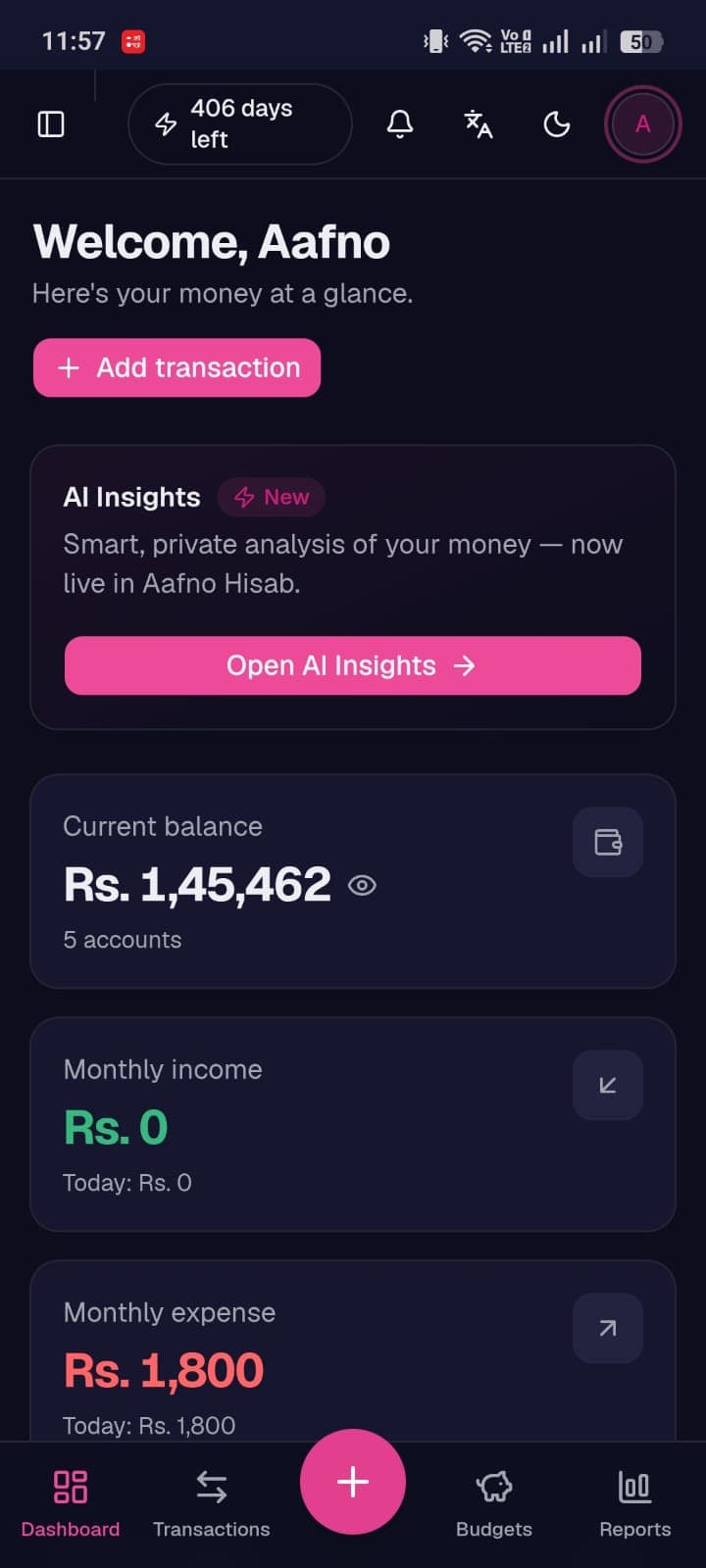
Aafno Hisab is built for the daily-record half of that: four seconds to enter an expense on a phone, a running balance for every customer, tenant or student, and everything exports to Excel or PDF whenever your accountant asks. It works offline, in Nepali or English, on the Bikram Sambat calendar. See what it does.
Common questions
Is Excel good enough for a small business in Nepal?
For many businesses, yes. Spreadsheets are free, endlessly flexible, owned outright, readable by any accountant, and unbeatable for one-off analysis like comparing suppliers or modelling a price change. If your bookkeeping is a monthly summary rather than a daily record, a spreadsheet is probably the right tool.
When should a business move from a spreadsheet to an app?
When you enter transactions daily on a phone while standing up, when you need a running balance per customer, when more than one person needs access at once, or when you need to be told things rather than having to look them up. Three or more of those and the spreadsheet is costing more than it saves.
What is the best way to track customer credit in a small business?
A running balance per person that is always current, without formulas to maintain or columns to add up. This is the single thing spreadsheets handle worst and that most Nepali small businesses need most, because the real question is always "who owes me what, right now" rather than "what happened last Tuesday".
How do I move my business records from Excel to an app?
Start with balances rather than history, what each person owes today and what each account holds today is enough to run the business. Keep the old file read-only so history stays available, run one month in parallel and then stop, and switch at the start of a Nepali month so the accounts have a clean line.
Will an app fix my bookkeeping problem?
Not by itself. Neither a spreadsheet nor an app enters data for you, and a business that does not write things down has a habit problem rather than a software problem. What a good app changes is the cost of the habit: four seconds on a phone where it happens, instead of an evening at a laptop.
Loans & EMI
Bike & Car Loan in Nepal: Down Payment, EMI, Hidden Costs