Udharo in English: Loan, Credit, or Neither? · Aafno Hisab
Udharo
Udharo in English: What It Means and How to Track It
6 min read · Published 31 Aug 2026 (15 Bhadra 2083)
Updated 29 Sept 2026 (13 Aswin 2083)
Try this. Take two minutes and list every rupee that is currently out of your hands and in someone else's.
The cousin during Dashain. The colleague at the tea shop who was short. Rs. 500 for a taxi, Rs. 5,000 for a hospital visit, Rs. 20,000 for someone's brother's fees. Most people who do this exercise honestly arrive at a number between Rs. 10,000 and Rs. 50,000, and are genuinely surprised by it.
This is udharo.
What does udharo mean in English?
Udharo (उधारो) is money lent informally between people who know each other, with no paper, no interest and usually no fixed date to repay. The closest English is "informal lending" or simply "money lent to a friend"; the nearest single word is a loan, but that word implies terms and paperwork, and udharo has neither.
It is one of the best things about how we live here. Someone is short, someone else has it, and the money moves without a bank, a form or a credit check. It is also where a remarkable amount of household money quietly goes to sleep.
Two things it is not. It is not a gift, even though it can quietly become one. And it is not meter byaj or any kind of moneylending, which carries interest and is a different thing entirely.
Why we forget it
It is not carelessness. Four things work together.
There is no record. A bank loan has a schedule and an SMS every month. Udharo has a moment: somebody needed money and you had it. Nothing was created that will remind either of you.
There is no date. "Pachi dinchhu", I will give it later. Later is not a date, so it never arrives, so nobody is ever late.
Asking feels bad. Reminding someone about money implies you think they forgot, or worse, that you do not trust them. So the reminder gets postponed, and the more it is postponed the harder it becomes.
Time flattens the memory. After three months you are not sure if it was Rs. 3,000 or Rs. 5,000, and being wrong about the amount is more embarrassing than losing it. So you say nothing.
What it costs
Take an average of Rs. 25,000 out on loan at any time. That is:
There is a second cost that is harder to count. Money that is never asked for does not just vanish from your account, it sits in the relationship. Most people would rather be repaid and stay close than write it off and quietly withdraw.
Four habits that fix it
1. Write it down at the moment, in front of them
The record has to be created while the money is changing hands, not later from memory. Ten seconds on your phone: who, how much, today's date.
Doing it openly also changes the transaction slightly, and for the better. Nobody is offended by a record. It is a signal that this is real money and both of you are treating it seriously.
2. Say a date out loud
Not "whenever you can". A month, a festival, a payday. "Dashain agaadi bhaye hunchha?", before Dashain works?
A date does three things: it lets them plan, it gives you a moment to follow up that is not personal, and it converts an open-ended favour into an agreement. Most people are relieved by it, being unsure how long they have is uncomfortable for them too.
3. Only lend what you can afford to lose
Old advice, and still the right test. If the money not coming back would change your month, that is not a loan you can make comfortably, and a loan you are anxious about will damage the friendship whether or not it is repaid.
Lending less than you were asked for is a real option. "Rs. 5,000 chai milchha" is a complete answer.
4. Ask early, ask lightly
The best time to remind someone is before it becomes awkward, a few days before the date you agreed, when nothing is wrong yet.
Something like:
"Hey, that Rs. 5,000, you said before Dashain, hai? Just checking, no pressure at all."
Short, warm, and it references the agreement rather than their character. If they cannot pay yet, agree on a new date the same way. What kills relationships is not asking; it is six months of silence followed by resentment.
When it has already been a year
Sometimes the moment has passed. Two things still work:
Be honest that you had forgotten too."Yaar, I completely lost track of this, did I lend you 5 or 10?" Sharing the vagueness removes the accusation, and people usually correct you upwards.
Offer instalments before they ask."Rs. 1,000 a month is fine if that is easier." An amount someone can actually pay gets paid. An amount they cannot gets avoided.
And if you decide to let it go, do that consciously, say it, or say nothing and genuinely close the file. A forgiven loan you keep thinking about is the worst of both.
Let the app remember for you
The one habit that makes the other three possible is the record, and it has to be quicker than the excuse not to make it.
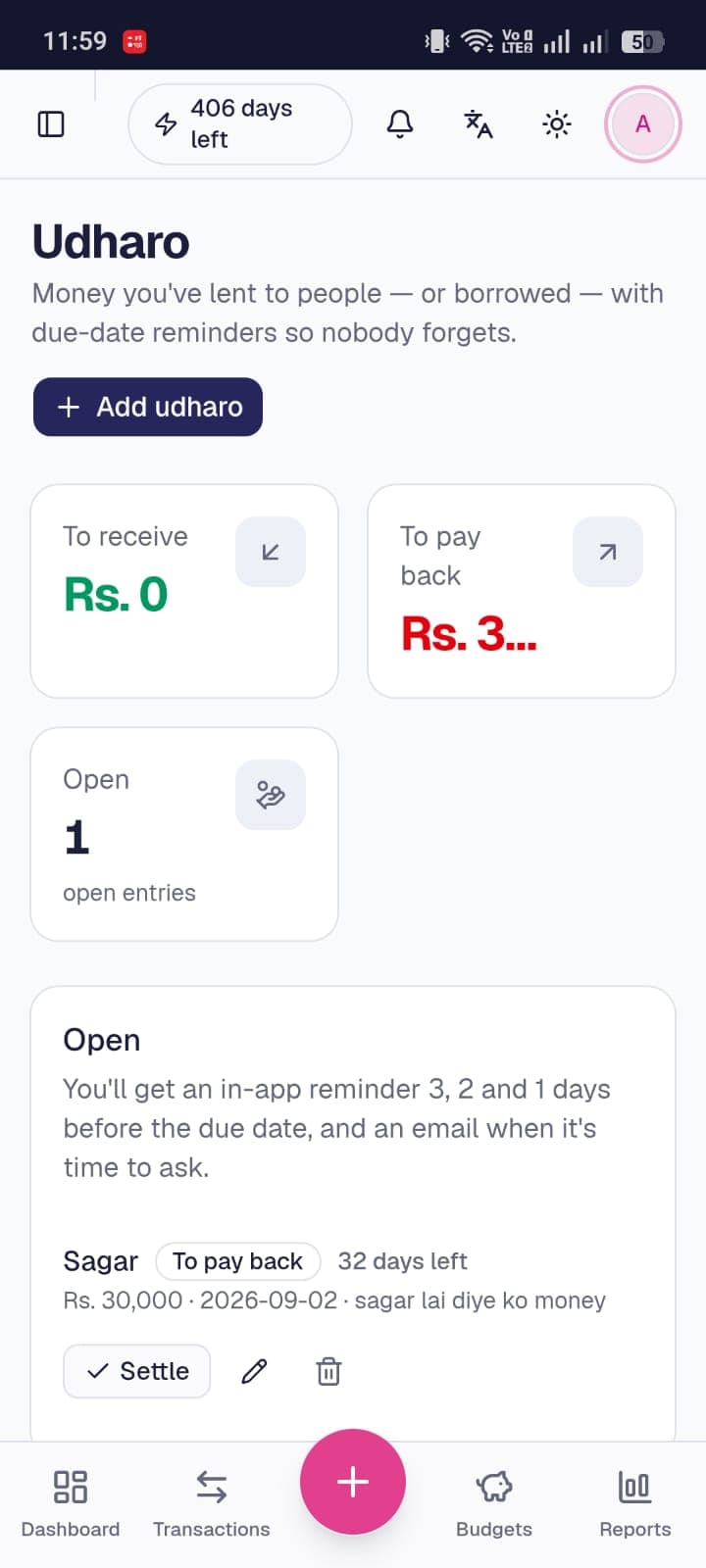
Aafno Hisab has udharo built in, not as a workaround with categories, but as its own thing, because in Nepal it is its own thing.
Record who, how much, and when you should get it back, in about ten seconds
The app reminds you 3, 2 and 1 days before that date, in the app and by email
One screen shows everything you have lent and everything you have borrowed
It works offline, so you can record it at the tea shop and it syncs later
The reminder is the part that matters. It arrives before the date rather than long after, which is exactly when asking is still easy.
The short version
Udharo is forgotten because nothing gets written down and no date is agreed
Most people have Rs. 10,000–50,000 out at any time without knowing it
Record it in the moment, agree a date out loud, lend only what you can lose, and ask early and lightly
A reminder before the date turns an awkward conversation into a normal one
Udharo is money lent informally between people who know each other, with no written agreement, no interest and usually no fixed repayment date. English has no single word for it: "informal lending" is the closest description, and "a loan" is misleading because it implies terms and paperwork that udharo does not have.
What is udharo in Nepali?
उधारो is the Nepali word for money given to someone on trust, to be returned later. In everyday use it covers two related things: money lent between friends and relatives, and goods taken on credit from a shop to be paid for later, which is usually written in the shop's khata.
Is udharo the same as a loan?
Not quite. A loan has an agreed rate, a schedule and usually a document. Udharo has none of those, which is what makes it easy to give and easy to forget. The absence of interest and paperwork is the point, but it is also why the money so often stays out for years.
How do I ask someone to return my udharo?
Ask early and ask lightly, before it becomes a large amount or a long time. A short message naming the amount works better than a general reminder, and asking at three weeks is a normal conversation while asking at three years is an awkward one. The habit that prevents it entirely is saying a return date out loud when you hand the money over.
How much udharo does a Nepali household have out?
Most people who list it honestly arrive at somewhere between Rs. 10,000 and Rs. 50,000 currently lent out, and are surprised by the total. The figure is rarely one large amount; it is many small ones nobody wrote down.
Loans & EMI
Bike & Car Loan in Nepal: Down Payment, EMI, Hidden Costs