How Much Loan Can I Get on My Salary in Nepal?
7 min read · Published 31 Aug 2026 (15 Bhadra 2083)
Updated 29 Sept 2026 (13 Aswin 2083)
Before you fill in any form, the bank has already decided roughly what it will lend you. The calculation is not secret and it is not complicated, you can do it yourself in two minutes and walk in knowing the answer.
It rests on a single idea: how much of your monthly income can safely go to loan instalments.
The rule banks use
Most lenders in Nepal cap your total EMIs at somewhere between 40% and 50% of your net monthly income. Some go higher for very high earners or salaried customers at the same bank; some go lower if the income is irregular.
Take 40% as the conservative figure and work from there:
Monthly income          Rs. 50,000
EMI cap at 40%          Rs. 20,000
Existing EMIs           Rs. 0
Available for a new EMI Rs. 20,000
Then the bank turns that instalment into a loan amount using the rate and the tenure. That is the whole method.
What Rs. 20,000 a month buys
At 12% a year, the same instalment produces very different loans depending on how long you take:
Read that table twice. Stretching from 5 years to 15 years raises what you can borrow by about 85%, and raises the interest you pay by more than six times.
This is the trade every borrower makes without being told they are making it. A longer tenure is not cheaper; it is smaller instalments and a much larger total.
What existing loans do to the number
Everything you already pay comes off the top, including a bike loan, a personal loan, and often a share of your credit card limit.
Same Rs. 50,000 salary, but with a Rs. 8,000 bike EMI running:
EMI cap at 40%          Rs. 20,000
Existing EMI            Rs. 8,000
Available                Rs. 12,000
Eligible at 12%, 15 yrs  Rs. 9,99,860
The bike costs you Rs. 6,66,574 of borrowing capacity. Worth knowing before you take a small loan for something you could have waited for.
What makes the number bigger
- A co-applicant. Adding a spouse's or parent's income is the single biggest lever most people have.
- A longer tenure. More eligibility, far more interest. Use it to qualify, then prepay.
- Clearing a small existing loan first. Removing a Rs. 5,000 EMI can add several lakh to what you qualify for.
- Salary through the same bank. Many lenders treat their own account holders more generously.
What makes it smaller
- Irregular or undocumented income. If it is not on a bank statement, it is hard to count.
- A short employment history. Most banks want you confirmed and several months in.
- Missed payments anywhere. Nepal's credit information system records defaults, and they follow you.
- Age near retirement. The loan has to finish before your income does.
What eligibility does not tell you
The bank is answering "what can this person repay?" It is not answering "what should this person borrow?"
Two different questions. Before taking the full amount you qualify for, check:
- Would the EMI survive a bad month? A hospital bill, a job change, a slow season.
- Do you have an emergency fund? Three to six months of expenses is what stops an EMI turning into a default.
- Is there a cheaper way? If the alternative is an interest-only loan from a sahakari, the bank is usually the cheaper option, even though it feels heavier.
A good rule: borrow the amount whose EMI you could still pay if your income dropped by a quarter.
Documents you will be asked for
Roughly, for a salaried applicant:
- Citizenship and passport-size photos
- Salary certificate and appointment letter
- Six to twelve months of bank statements
- Tax clearance or PAN, depending on the bank
- Collateral papers for a secured loan, or a guarantor for an unsecured one
Getting these together before you apply shortens the process considerably.
Work out your own number
Aafno Hisab has a loan eligibility calculator that runs exactly this arithmetic: it takes your income and existing EMIs, applies the 40% cap, and shows the loan amount and the total interest for the tenure you choose. Changing the tenure and watching the interest column move is the fastest way to understand the trade-off above.
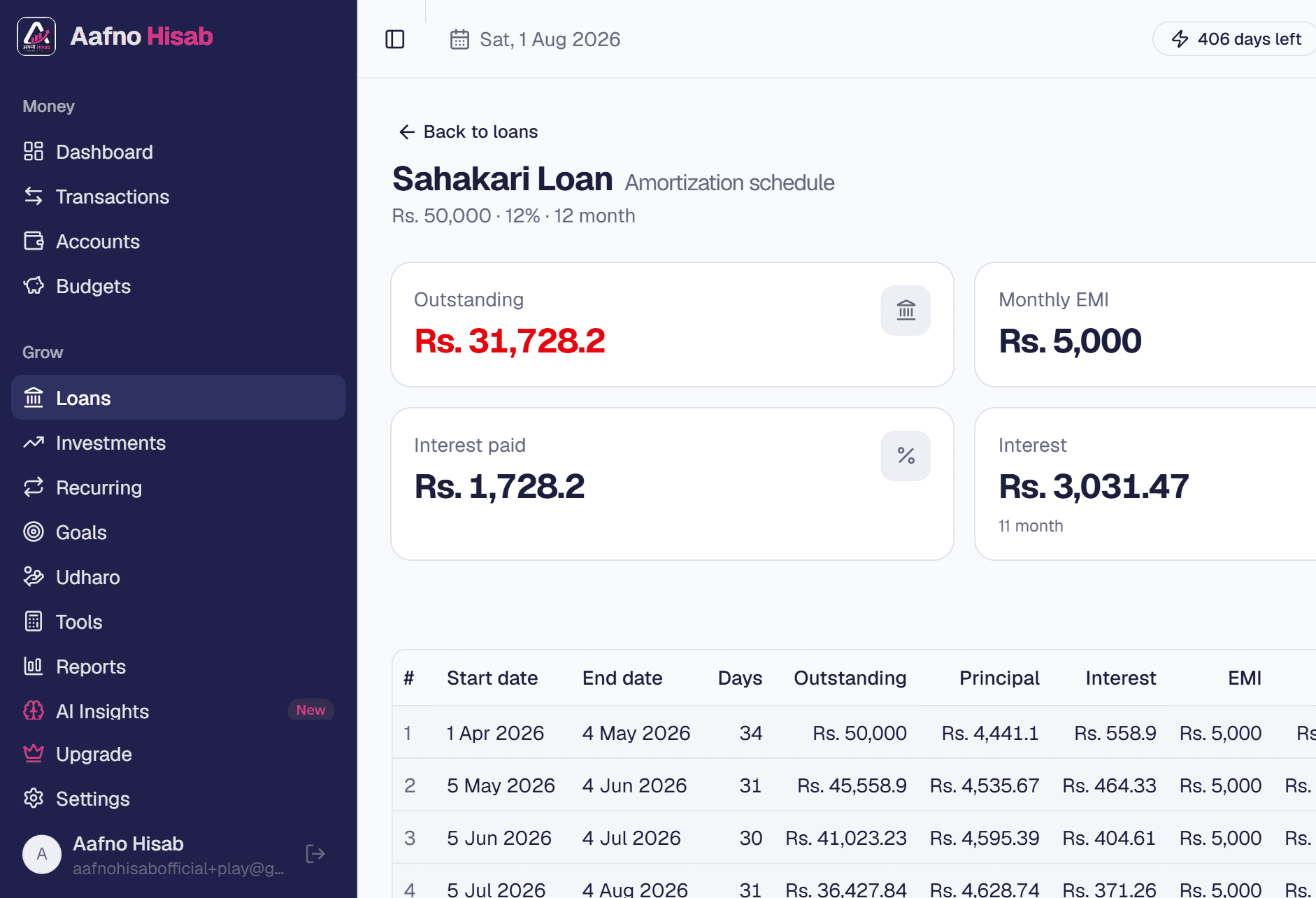
Once you take the loan, the app tracks it with a bank-style amortization schedule, with day-count interest and the principal-interest split on every instalment, so you can check the bank's sheet against your own.
The short version
- Banks cap total EMIs at roughly 40-50% of net income
- Rs. 50,000 income with no existing loans supports about a Rs. 20,000 EMI
- At 12%, that is Rs. 8.99 lakh over 5 years or Rs. 16.66 lakh over 15
- The 15-year version costs more than six times the interest
- Existing EMIs come straight off the top, a Rs. 8,000 bike loan costs you Rs. 6.6 lakh of capacity
Related: Bank EMI vs sahakari loan · How to make a monthly budget