Pasal Udharo Khata: How to Track Shop Credit in Nepal · Aafno Hisab
Business
Kirana Pasal Udhaaro: Keeping a Khata That Actually Balances
9 min read · Published 10 Sept 2026 (25 Bhadra 2083)
Every kirana pasal in Nepal runs on credit, and no shopkeeper decided to. It happens one Rs. 200 at a time, to people you see every day, in a neighbourhood where saying no is expensive in ways that do not show up in a ledger.
The khata under the counter starts honest. By Mangsir it has a page where the handwriting changed, two entries nobody can date, and a name with no amount beside it. Not because anyone was careless, because a book you write in with one hand while weighing dal with the other is a book that will eventually stop agreeing with reality.
This is about giving credit on purpose instead of by accident.
What udhaaro actually costs you
Take a shop doing Rs. 18,000 a day. That is a normal, healthy neighbourhood pasal.
Say : customers who take now and settle later. That is Rs. 6,300 a day, so at any moment roughly
Rs. 1,89,000 of your stock is sitting in other people's kitchens.
On a gross margin of around 12%, that shop makes about Rs. 64,800 a month.
Now the part that hurts. If 5% of the credit is never collected: not stolen, just people who moved, or forgot, or you stopped asking, that is Rs. 9,450 a month.
Read those two numbers together: Rs. 9,450 of a Rs. 64,800 profit. Fifteen percent of everything the shop earns, gone to credit that quietly expired.
And that is before the second cost, which is worse and never counted: the Rs. 1,89,000 tied up in credit is Rs. 1,89,000 you cannot use to buy stock at a discount, take a bulk rate, or pay a supplier early. You are financing your customers out of your own working capital, at zero interest, with no agreement.
Credit is not the enemy here. Unmeasured credit is.
Why the shop khata fails differently from other ledgers
A hostel bills the same amount to the same people on the same day. A shop is the opposite in every dimension, and that is why the same system does not work:
The amounts vary: Rs. 80 today, Rs. 640 on Saturday.
The timing is random: you cannot cycle anything monthly.
The entries are made mid-transaction, one-handed, with a queue waiting.
Nobody signs anything, so a disputed entry is your word against a regular customer's.
Settlement is partial and constant: Rs. 500 against Rs. 1,340, and the rest "next week".
So the shop khata does not need a billing cycle. It needs three things the notebook cannot do: a running balance per person, a limit, and an age.
The three numbers that matter
1. The running balance
Not a list of entries, a number. At any moment you should know that Sita didi is at Rs. 1,340, without adding anything up.
If the only way to get that number is to add a column of figures, you will not do it, and if you do not do it you cannot do anything else in this article.
2. The limit
This is the one almost nobody sets, and it is the whole solution.
Decide a maximum for each customer before they reach it. Rs. 2,000 for a new face, Rs. 5,000 for someone who has settled every month for two years. Write it next to their name.
The limit changes the conversation completely. Without one, refusing credit is a judgement about a person, I don't trust you, and that is why you never refuse. With one, it is a rule that exists for everybody, dai, you're at 2,000, let's clear it and start again. Nobody takes a rule personally. Everybody takes a judgement personally.
Set the limits on a quiet afternoon, not in the moment. The moment is when you say yes to things you should not.
3. The age
A balance of Rs. 1,000 from last week and a balance of Rs. 1,000 from four months ago are completely different situations, and a khata that only stores amounts cannot tell them apart.
Old credit is what turns into lost credit. Roughly:
Age
What it means
Under 30 days
Normal. This is the business working.
30–60 days
Mention it, lightly, next time they are in the shop.
60–90 days
Stop extending. Settle before more goes out.
Over 90 days
Assume you will get part of it, and act now.
The single highest-return habit in this business is looking at the oldest balances once a week. Not the biggest, the oldest. Big and recent is a good customer. Small and old is money leaving.
The rules that make it work
Write it down in front of the customer, every time. Not later, not from memory at closing. In front of them, so they see the number and so they can correct it there and then. An entry the customer watched you make is an entry they will not dispute in three months.
Say the running total out loud when they take credit."Two eighty today, that makes eleven forty." It costs you two seconds and it does the entire job of debt collection without a single reminder. Most people settle simply because they were told the number.
Never let a settlement be verbal. When they pay Rs. 500 against Rs. 1,340, the balance becomes Rs. 840 and it must be visible immediately. Part payments that are not recorded properly are the single largest source of khata disputes.
One khata, not one per book. If credit is written on the back of the calendar when the notebook is out of reach, you have two systems and neither is true.
Review weekly, chase monthly. Ten minutes on a Saturday to look at the oldest balances. A short, friendly message on the first of the month.
Who should not get credit, and how to say so
You already know who. The problem is never knowing, it is saying it.
Have a policy rather than an opinion, and let the policy do the refusing:
New customers: cash for the first month. "Naya customer lai policy ho, dai."
Anyone over their limit: clear it, then continue. Not a negotiation.
Anyone over 90 days: no new credit until it is settled.
Alcohol and cigarettes: cash, always. This is the most common single rule among shops that do not lose money, and it exists because those balances are the ones that never come back.
A policy is easier to say and easier to hear. And when you write it on a card and stick it near the counter, you stop being asked.
Chasing without losing the customer
Your customer lives fifty metres away and will still live there next year. The chase has to survive that.
Send a number, not a request."Namaste dai, khata Rs. 1,340 chha. Sajilo bhaye milaunu hola." Specific, brief, no accusation.
Send it to everyone on the same day, so it reads as the shop's routine rather than as a message about them.
Offer instalments before you offer a discount. Someone paying Rs. 500 a week is a customer. Someone given a 20% discount to settle has learned exactly what waiting is worth.
Stop extending before you start chasing. Chasing while still giving credit teaches the opposite of what you intend.
The monthly ten minutes
What is the total udhaaro out there? One number. If it is growing every month, your limits are too high.
Who is over their limit? Those conversations happen this week.
What is older than 90 days? Decide: instalments, or write it off and stop the bleeding.
Did the total collected match the cash and the bank? If not, find out now.
Anyone who has settled cleanly for six months? Raise their limit. Reward is part of the system too.
The short version
Credit is fine. Unmeasured credit is what costs you: 5% unrecovered can be 15% of your profit.
You need three things per person: running balance, limit, age.
Set the limit before it is reached. A rule refuses for you; without one, you have to.
Write it in front of the customer and say the running total out loud.
Record part payments immediately, always.
Watch the oldest balances, not the biggest.
Cash only for new customers, and for cigarettes and alcohol.
A shop that gives Rs. 1,89,000 of credit is running a small lending business alongside the pasal. Nothing wrong with that, but it should be run like one, with limits and dates, and not on the back of a calendar.
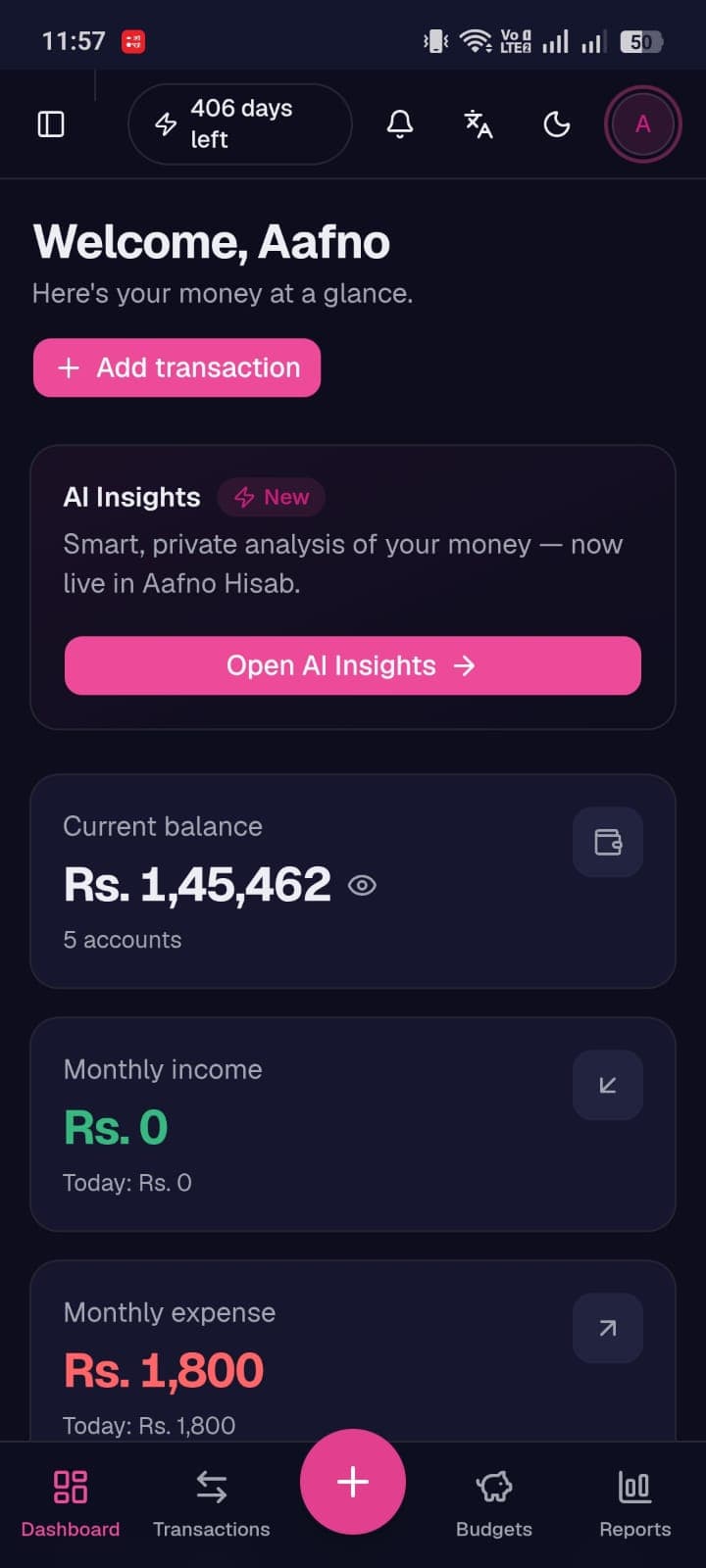
Khata in Aafno Hisab keeps a page per customer with the running balance already added up, records part payments so the remainder carries forward on its own, shows how long each balance has been outstanding, and has a WhatsApp reminder ready with the amount in it. Nepali or English, Bikram Sambat calendar, and it keeps working when the network does not. See what it does.
For money lent to friends and relatives rather than customers, the udharo tracker handles the version with no monthly rhythm at all.
Common questions
How do I keep a udharo khata for my shop?
Keep three things for every customer: a running balance you can read without adding anything up, a credit limit set before it is reached, and how long the balance has been outstanding. Write each entry in front of the customer, say the new running total out loud, and record part payments immediately so the remainder is always visible.
How much credit should I give a customer?
Set a limit per person in advance, smaller for a new face, larger for someone who has settled every month for years, and write it beside their name. The limit is what allows you to refuse: without one, saying no is a judgement about a person, which is why shopkeepers never say it. With one, it is a rule that applies to everybody.
What does unpaid shop credit actually cost?
On a shop taking Rs. 18,000 a day with 35% on credit, about Rs. 1,89,000 of stock is outstanding at any moment. If 5% is never collected that is Rs. 9,450 a month, around 15% of the shop's gross profit. The second cost is the working capital tied up, which cannot be used to buy stock at a better rate.
How do I ask a customer to clear their udharo?
Send the number rather than a request, briefly and without accusation, and send it to everyone on the same day so it reads as the shop's routine. Offer instalments before offering a discount: a customer paying weekly is still a customer, while a discount for settling teaches everyone what waiting is worth.
Which customers should not get credit at all?
New customers for the first month, anyone already over their limit, anyone with a balance older than ninety days, and, in most shops that stay profitable, cigarettes and alcohol on any account. Writing the policy on a card near the counter means you stop having to refuse people individually.
Loans & EMI
Bike & Car Loan in Nepal: Down Payment, EMI, Hidden Costs