Best Personal Finance App in Nepal? 6 Checks · Aafno Hisab
Guides
How to Choose a Personal Finance App in Nepal
11 min read · Published 7 Sept 2026 (22 Bhadra 2083)
Updated 29 Sept 2026 (13 Aswin 2083)
Five years ago the honest answer to "which finance app should I use in Nepal" was a shrug and a spreadsheet. Every option was built somewhere else, showed dollars, and had no idea what Ashwin was.
That is over. There are now several genuinely Nepali apps, and they are good. Which creates a new problem: they look almost identical on a listing page, they all say "made for Nepal", and there is no way to tell from the Play Store which one fits you.
We make one of them, so read this knowing that. It is also why the article is written the way it is: naming where the others are better is the only way a comparison from a competitor is worth reading.
Not "which app is best". Ask: where does my money actually sit?
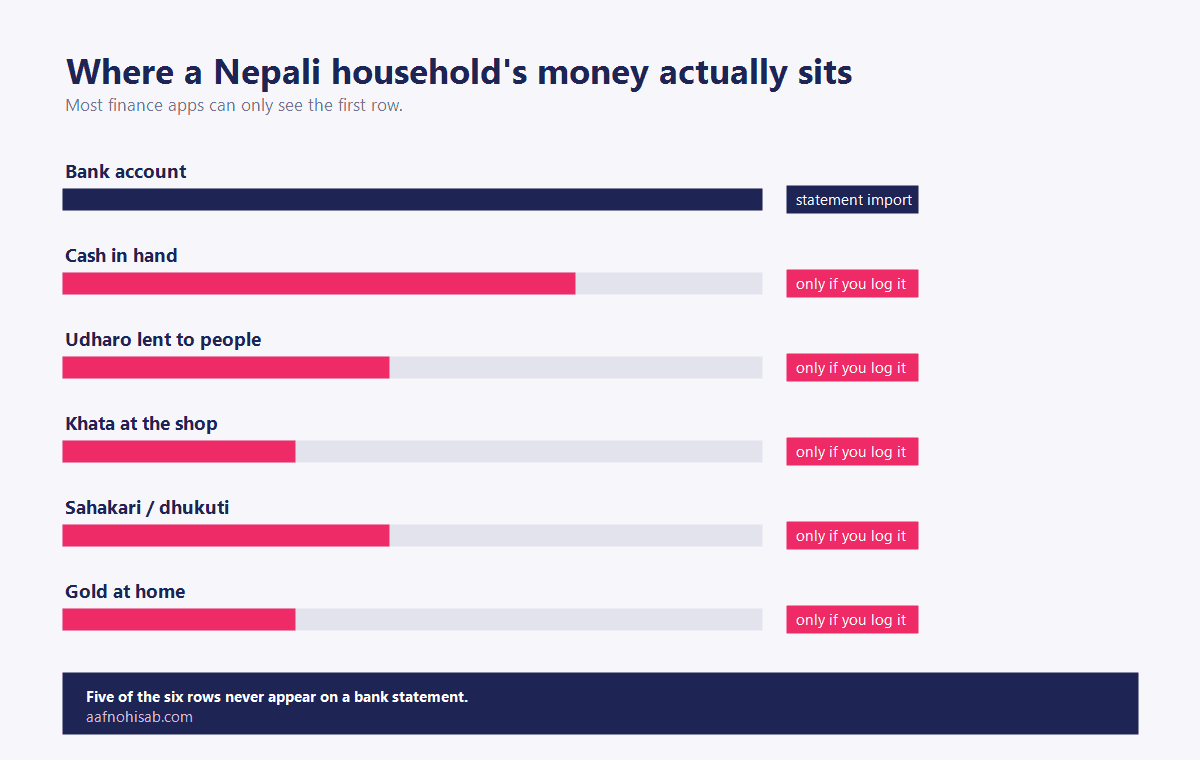
That picture is the whole decision. A Nepali household typically holds money in six places, and only one of them produces a statement:
The bank account, which is documented
Cash in hand, which is not
Udharo, money lent to a cousin or a neighbour
Khata, credit running at the shop, or fees owed to you if you run one
A sahakari, dhukuti or committee, often interest-only
Gold, sitting at home
An app built around importing bank statements gives you a beautiful, accurate picture of row one. If row one is 90% of your money, that app is excellent and you should use it. If row one is 40% of your money, that app will tell you a confident story about the wrong half.
Work out your own split before you download anything. Take last month: what share left your bank, and what share was cash, lent, owed or paid to a sahakari? Everything below follows from that number.
The Nepali options, honestly
A short and deliberately fair map of what exists, at the time of writing. Check current features yourself, since all of these ship changes often.
Kharchapatra is built around importing bank and wallet statements, with auto-categorisation, BS and AD throughout, and a tax helper. If your spending is mostly card and bank transfer, it does the tedious part for you, which is the strongest possible argument for it. Free during beta at the moment.
EZer is a clean, simple expense and budget tracker with a strong privacy stance: local-first, encrypted, and explicit that data is not sold. Free tier plus a paid plan around Rs. 299 a month. If you want the basics done well and nothing else, this is a serious option and it is cheaper than we are.
Bhudki is fully offline and privacy-first, aimed at students, freelancers and families, with BS support and custom budgets. If you want nothing on a server at all, that is the pitch.
Mero Hisab leans towards a ledger and interest assistant, with BS dates and loan calculation.
Karobar is not really a personal finance app. It is digital khata for businesses, and it is the strongest thing in Nepal for a shop that wants billing and inventory. If your question is about running a business rather than a household, start there.
Your bank's own tool. Several banks now include a budgeting view inside their app. It is free, it needs no setup, and it sees your bank account perfectly. It also cannot see anything else, and it stops working the day you change banks.
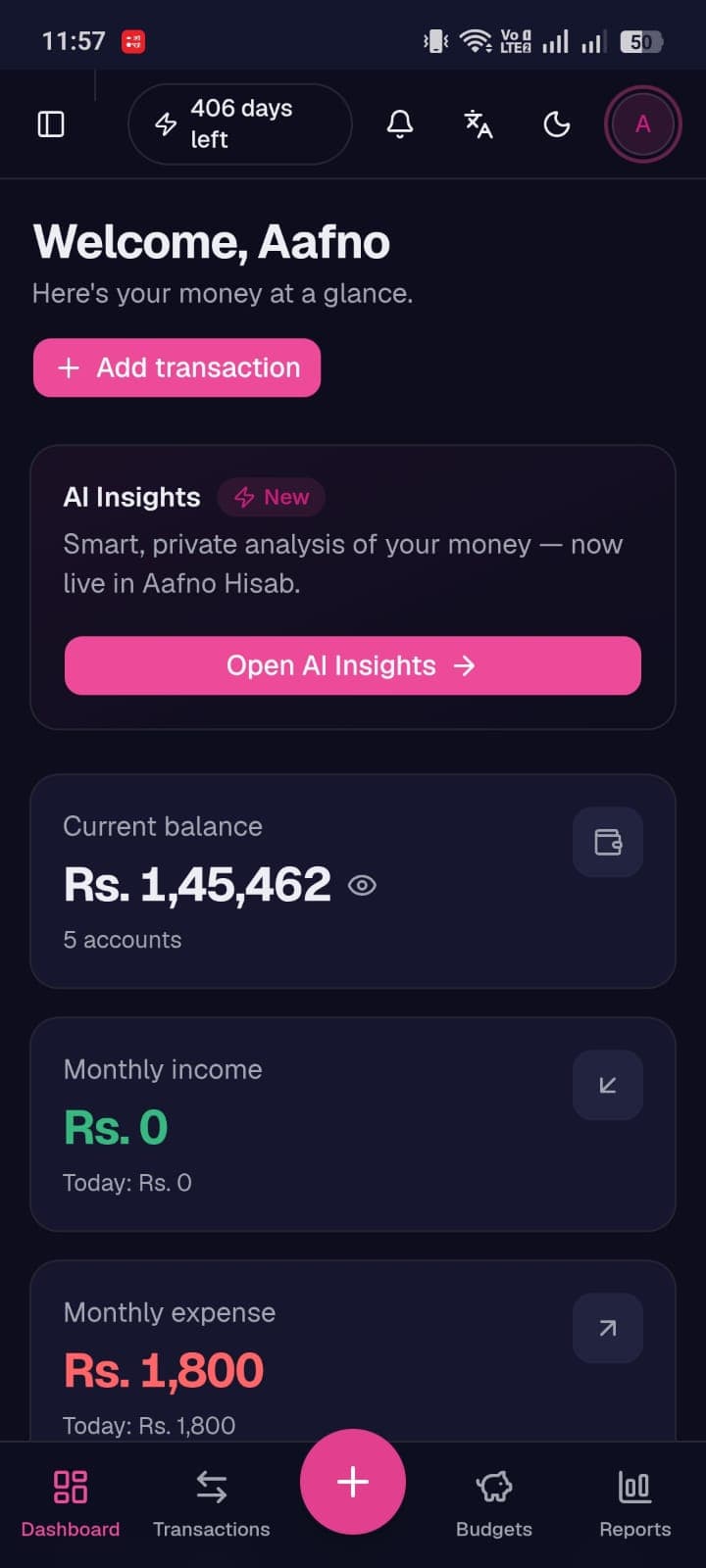
Aafno Hisab, ours, is built for the households where rows two to six are large: cash entry in a few seconds, udharo with reminders, a khata page per person, interest-only sahakari and relative loans alongside bank EMI, and full offline capture. Almost all of it is free, including budgets, loans and reports; only khata, udharo reminders, AI and export are paid, at Rs. 500 a month.
The six checks that actually separate them
Feature lists are useless here, because everyone lists the same features. These are the things that differ once you use an app for a month.
1. How long does one expense take?
This is the single strongest predictor of whether you will still be using an app in three months. Not the charts. The entry.
Stand in a shop, buy something for Rs. 90, and time it: unlock, open, amount, category, save. Under about ten seconds and the habit survives. Over thirty and it will not, however good the reports are.
Test this before you commit, with the app you are considering, in an actual shop.
2. Does it work with no signal?
Nepal has plenty of places where the bars are showing and nothing loads. There is a real difference between an app that stores your entry and syncs later and one that shows a spinner and loses it.
The test is easy: turn on flight mode, add a transaction, turn the network back on, and see whether it is there. Do it before you trust it with a month of entries.
3. Bikram Sambat, everywhere or only on the date field?
Almost every Nepali app now shows BS dates. Far fewer let you budget by the Nepali month, which is what actually matters, because your rent, your salary and your festival spending follow Ashwin and Kartik, not January.
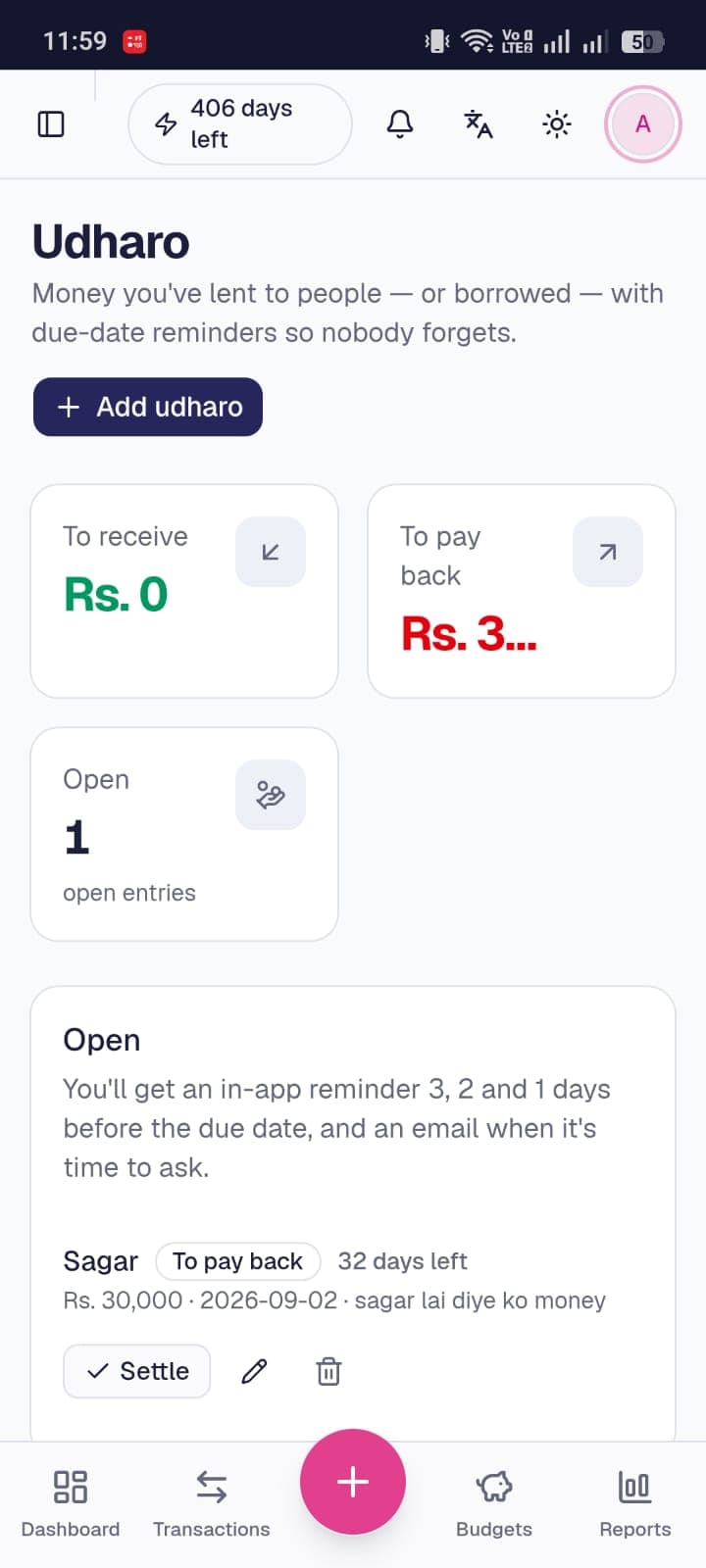
The specific question: can you record money you lent to a person, with a date to ask for it back, and be reminded? And if you run a shop, hostel or rental, can you keep a running balance per person rather than a pile of transactions?
What you are looking for is a screen like that one: a person, an amount, a date it is due back. If the only way an app can hold this is as an expense with a note, it cannot remind you, and reminding you is the entire point.
5. Does it understand the loans you actually have?
Bank EMI is the easy case and everyone handles it. The harder ones are common here and often missing:
Interest-only loans from a sahakari or a relative, where you pay interest monthly and the principal sits untouched
A schedule that actually matches the bank's sheet, so you can check theirs against yours
6. Can you get your data out?
Ask this before you put a year of your life into an app. Export to Excel or PDF, whenever you want, without asking anyone.
An app that cannot export is an app you cannot leave. That matters more than any feature on the list, because the one prediction I can make confidently about a young Nepali app market is that some of these products will not exist in three years.
What most people get wrong
Choosing on features. Every app lists twenty. You will use four. Choose on how fast entry is and whether it holds your kind of money.
Choosing on price alone. The gap between free and Rs. 500 a month is Rs. 6,000 a year. If an app helps you notice one leak, and the ordinary ones run to about Rs. 8,000 a month, the arithmetic is not close. But it only works if you actually use it, which loops back to entry speed.
Downloading three and using none. Pick one, use it for a full month including the awkward days, and then judge. A month of real entries tells you more than a year of comparing.
Ignoring the free tier's shape. Everyone has a free tier. What matters is what falls outside it. Ours keeps budgets, loans, recurring entries and reports free and charges for khata, udharo reminders, AI and export; check where yours draws it. Read the boundary before you start.
A month-long test that settles it
If you cannot decide, do this instead of reading more comparisons.
Pick two apps, not five.
Enter the same week of spending in both. Real spending, including the cash.
Note how long each entry takes, honestly.
Try one thing that is not a plain expense: money lent to a friend, an EMI, a shop credit.
Export from both at the end of the week.
Delete the one that annoyed you. It will keep annoying you.
Anyone who survives that week with you is the right app.
Common questions
What is the best personal finance app in Nepal?
There is no single answer, because the apps solve different problems. If nearly all your money moves through one bank account, an app built on statement import saves you the most work. If a large share is cash, udharo, khata, a sahakari loan or gold, you need one that records those directly, because none of them appear on a statement. Work out your own split first, then choose.
Is there a Nepali app with the Bikram Sambat calendar?
Several now support BS dates, including Kharchapatra, Bhudki, Mero Hisab and Aafno Hisab. The thing to check is whether BS goes beyond the date field: whether you can set and review a monthly budget on the Nepali month, which is what your rent, salary and festival spending actually follow.
Are free expense tracker apps in Nepal good enough?
For recording income and expenses, yes, and several free tiers are genuinely usable. The paid features are usually budgets, loans, reports and exports. The honest test is whether you would act differently with that information: if a budget alert or an EMI schedule would change a decision, it is worth paying for, and if it would not, stay on free.
Can a personal finance app track udharo and khata?
Some can. Udharo needs a record of who owes what with a date and a reminder, and khata needs a running balance per person rather than a list of transactions. Most general expense trackers, including the international ones, do neither, so if this is a large part of your money it is worth checking specifically rather than assuming.
Should I use my bank's budgeting tool instead?
If your money is almost entirely inside that one bank, it is free, accurate and needs no setup, which is hard to beat. Its limits are that it cannot see cash, other banks, wallets, lending or informal loans, and that your history goes with the bank if you ever move. It works well as a view of one account rather than as a picture of your finances.
How do I move from a spreadsheet to an app?
Bring balances rather than history: what each account holds today and what each person owes you today is enough to run from. Keep the old sheet read-only so the history is still there, run one month in parallel, then stop maintaining both. Starting at a Nepali month boundary gives the accounts a clean line. There is a longer version in our spreadsheet versus app comparison.
The short version
Ask where your money sits, not which app is best. Only the bank row produces a statement.
Statement import wins if your spending is bank-heavy. Direct entry wins if it is not.
Test entry speed in a real shop and offline capture in flight mode, before committing.
Check BS on the budget screen, not the date picker.
Check whether it holds udharo, khata and interest-only loans, if you have them.
Check export before you put a year into it.
Pick two, run a real week, delete the one that annoyed you.
Aafno Hisab is our answer for the households where cash, udharo, khata and sahakari loans are a large share of the money: entry in a few seconds, working offline, in Nepali or English on the Bikram Sambat calendar, with everything exportable whenever you want it. See what it does, or read the pricing.
Share this article
Loans & EMI
Bike & Car Loan in Nepal: Down Payment, EMI, Hidden Costs