Bikram Sambat or AD? Why Your Household Budget Should Follow BS
6 min read · Published 31 Aug 2026 (15 Bhadra 2083)
Updated 3 Sept 2026 (18 Bhadra 2083)
Here is a small thing that quietly ruins household budgeting in Nepal.
Your salary arrives at the end of the Nepali month. Your rent is due on a Nepali gate. School fees follow the Nepali academic year. Dashain and Tihar fall in Ashoj and Kartik. Almost every rupee that moves in a Nepali household moves on the Bikram Sambat calendar.
And then you open a budgeting app and it asks about August.
Why the mismatch matters
A Nepali month does not sit inside an English one. Bhadra runs roughly from mid-August to mid-September. So when an app tells you what you spent "in August", it is showing you the last two weeks of Shrawan and the first two of Bhadra, mixed together.
Three concrete problems follow:
Your salary lands in the wrong bucket. Paid at the end of Bhadra, the money shows up in September's chart. So August looks like a month with no income and September looks like a bumper one. Neither is true.
Rent gets counted twice or not at all. Paid on gate 1 of each Nepali month, rent occasionally lands twice inside one English month and skips the next. Your "spending" jumps for no real reason.
Festival spending is smeared. Dashain sits across the end of Ashoj and the start of Kartik. In an AD view it splits between two months, so neither one shows the spike, and you never see how much the festival actually cost.
The result is a budget that is technically accurate and practically useless: the numbers are right, but they are grouped into periods that do not match how you live.
What changes when you switch
Set your budgeting to Bikram Sambat and several things quietly click into place.
One salary, one month. Income and the spending it pays for land in the same period. Your monthly savings rate becomes a real number rather than an artefact of the calendar.
Rent appears once. As it does in life.
Festivals become visible. Ashoj shows a large number and Kartik shows a large number, and you can finally answer "how much did Dashain cost us?", which is the first step to saving for it in advance rather than borrowing for it.
Comparisons make sense. Bhadra against Bhadra is comparing like with like. August against August is not, because the two Augusts covered slightly different Nepali periods.
The one genuine argument for AD
Some things really do run on the English calendar: international subscriptions, credit card cycles, a foreign employer's payroll, remittance from a Gulf or Malaysian job.
If most of your money moves on AD, use AD. The rule is not "BS is more correct", it is match your budget to whichever calendar your money actually follows. For most households in Nepal, that is BS. For a family living mainly on remittance, it may not be.
The Nepali year, for budgeting purposes
Worth having in your head when you plan:
Two useful conclusions fall straight out of that table. Start putting money aside for Dashain in Shrawan, four months ahead. And treat Magh through Chaitra as the rebuilding season, because the year takes its money in Ashoj and Kartik.
How to switch
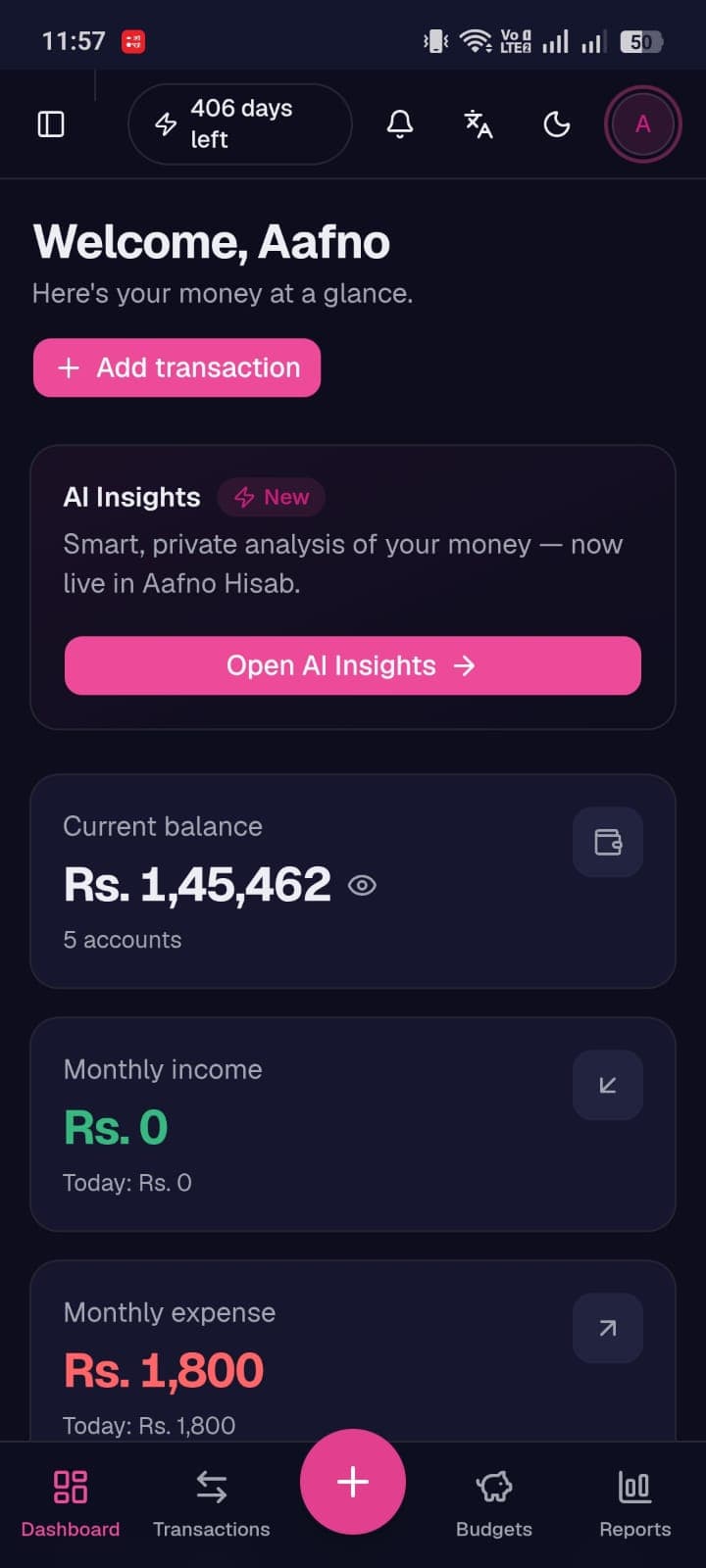
Aafno Hisab supports both calendars and lets you change at any time from your profile. Every date in the app, transactions, budgets, loan schedules, reports, follows whichever you pick, and the whole interface is available in Nepali as well as English.
Nothing is converted or lost when you switch; it is the same data, grouped the way you actually live.
The short version
- Salary, rent, school fees and festivals in Nepal follow Bikram Sambat
- An AD budget splits every Nepali month across two English ones
- That misplaces your salary, double-counts rent, and hides festival spending
- Switching makes month-to-month comparison meaningful for the first time
- Use AD only if your money genuinely moves on it, remittance, foreign payroll
- Plan Dashain from Shrawan; rebuild savings from Magh to Chaitra
Related: How to make a monthly budget in Nepal · 7 money leaks draining your salary