7 Money Leaks Draining Your Salary Every Month
7 min read · Published 31 Aug 2026 (15 Bhadra 2083)
Updated 3 Sept 2026 (18 Bhadra 2083)
The money that disappears from a Nepali salary rarely goes on anything big. There is no single Rs. 15,000 mistake. There are seven small ones, none of which feel like spending at the time.
Here they are with real monthly amounts, roughly what a working person in Kathmandu would recognise.
1. Chiya and khaja, Rs. 5,400
Rs. 60, three times a day, thirty days a month.
Nobody experiences this as an expense. It is Rs. 60. But it is the largest leak on this list and it beats most people's electricity bill.
The fix is not to stop. Cut one of the three and it is Rs. 1,800 back. Bring tea from home two days a week and it is more. The point is knowing that this line exists at all, because it never appears in anyone's mental budget.
2. Subscriptions you forgot, Rs. 1,200
A streaming service you last opened in Asar. A cloud storage plan for photos already backed up somewhere else. A gym membership from a determined January.
Auto-renewal is designed so you never make the decision again.
Fix: open your bank or wallet statement and read every recurring debit line by line. Most people find two they had forgotten. Ten minutes, and it stays fixed for a year.
3. Food delivery and eating out, Rs. 3,500
Not the planned dinner with friends, that is a want and it belongs in the budget. This is the tired Tuesday order because cooking felt like too much.
At Rs. 350–500 an order, twice a week, this line quietly reaches Rs. 3,500 a month.
Fix: decide in advance how many times a month, and let the rest be a real decision rather than a default. Recording each one at the moment you pay makes the count visible, which does most of the work.
4. Small online orders, Rs. 2,000
The Rs. 400 phone case. The Rs. 700 gadget. Individually trivial, collectively a bill nobody planned.
Fix: the oldest one still works, add it to the cart and buy it the next day. Most of these do not survive a night.
5. ATM and transfer fees, Rs. 400
Rs. 25 for using another bank's ATM, three times a month. Small transfer charges. Balance-below-minimum penalties.
Fix: withdraw larger amounts less often from your own bank's machine, and use eSewa or Khalti where they are free. Rs. 400 a month is Rs. 4,800 a year for nothing at all.
6. Interest you did not have to pay, Rs. 2,000+
This is the least visible leak and often the biggest.
If you carry a loan and have money sitting idle in a savings account, you are paying 12–18% on one side to earn 4% on the other. Every Rs. 10,000 of extra prepayment on a 12% loan saves you roughly Rs. 100 a month in interest for the rest of the term.
Worse, if the loan is interest-only from a sahakari, nothing you pay reduces the debt at all unless you deliberately pay down the principal.
Fix: run the numbers on prepaying. Idle savings beyond your emergency fund almost always belong against the most expensive debt.
7. Money you lent and never chased, Rs. 1,500 a month, effectively
Take the Rs. 18,000 that most people have lent out at any time, spread over the year it takes to drift back, if it comes back.
It is not a leak in the usual sense. It is money that exists but does no work: not in your emergency fund, not reducing your loan, not earning anything.
Fix: write it down when you lend it, agree a date out loud, and ask early and lightly. The record is what makes the reminder possible.
The total
On a Rs. 45,000 salary that is 36% of the income, more than most people's rent.
What to do with this
Do not try to close all seven. Nobody sustains that, and a month of grimness usually ends in a bigger spend.
Pick the two largest and halve them. Rs. 5,400 of chiya and Rs. 3,500 of delivery, halved, is Rs. 4,450 a month: which is an emergency fund milestone every seven months, or a meaningful prepayment on a loan.
And the step before any of it: track for one month. Every one of these numbers is invisible until it is written down, which is exactly why they survive.
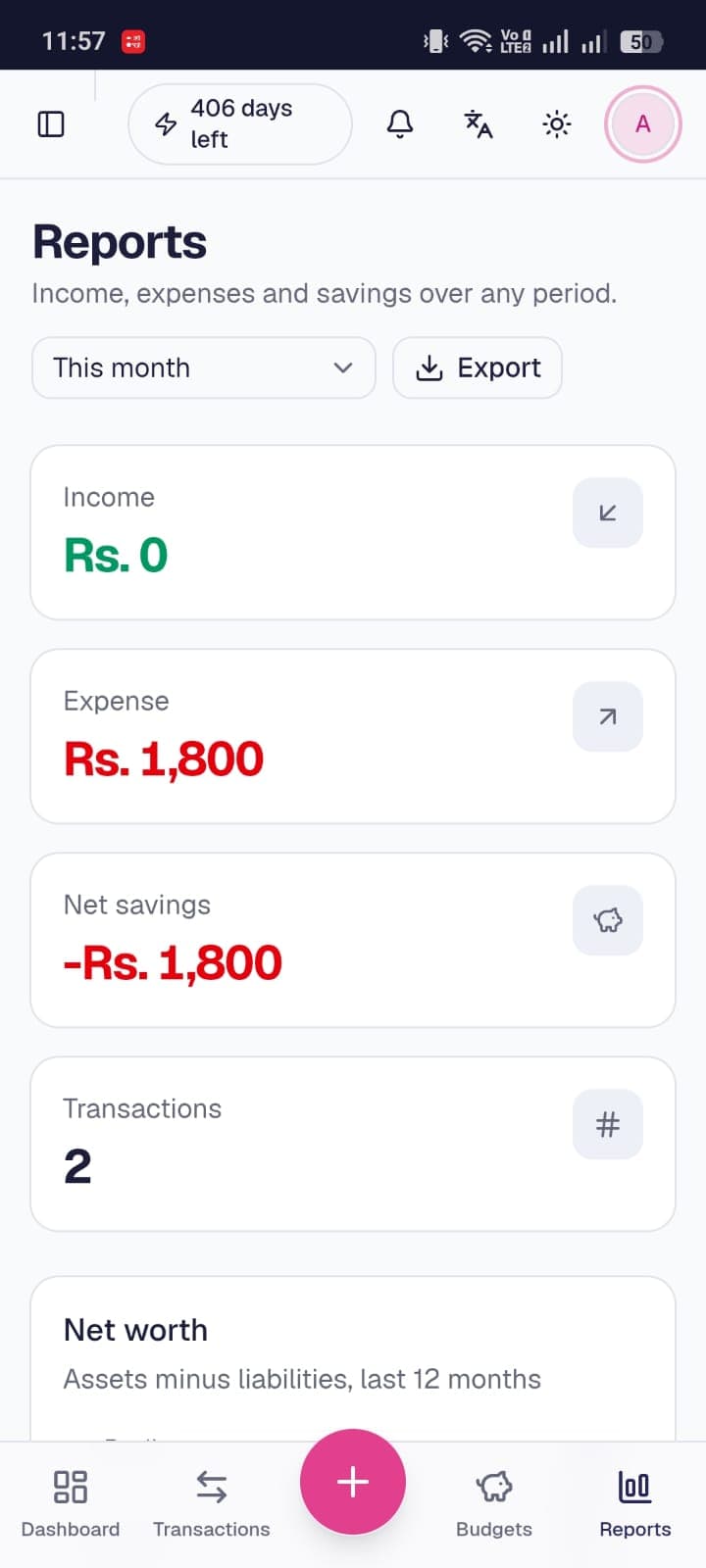
Aafno Hisab is free for recording income and expenses, works offline so you can log the chiya on the spot, and its category chart is usually where people first see leak number one for what it is.
The short version
- Seven small leaks add to roughly Rs. 16,000 a month on a normal Kathmandu budget
- The biggest is chiya and khaja at Rs. 5,400, nobody counts it
- Subscriptions and ATM fees are the easiest to close permanently
- Idle savings alongside an expensive loan is a leak, not safety
- Halve the two biggest rather than trying to close all seven
Related: How to make a monthly budget in Nepal · How much should you save every month?