Emergency Fund: How Many Months Can You Survive Without Income?
6 min read · Published 31 Aug 2026 (15 Bhadra 2083)
Updated 29 Sept 2026 (13 Aswin 2083)
Answer this before reading further: if your income stopped tomorrow, how many months could you carry on before something had to change?
Most people have a vague feeling, "a month or two, maybe". Almost nobody has the actual number, and the actual number is the most important one in personal finance. It decides whether a hospital bill is a problem or a crisis, and whether you can leave a bad job.
How to work it out
Two steps, and note the first one carefully.
1. Find your monthly expenses, not your income. What you spend is what you would need to keep spending. If you earn Rs. 45,000 and spend Rs. 39,000, the number that matters is 39,000.
2. Divide what you have saved and can reach quickly by that number.
Cash + bank + easily broken savings   Rs. 78,000
Monthly expenses                      Rs. 39,000
Months covered                        2.0
Two months. That is your real answer, and for a lot of working people in Nepal it is somewhere between zero and three.
What the target should be
The standard advice is three to six months of expenses. In Nepal there are two good reasons to sit at the higher end.
Notice periods are short and severance is rare. A job can end quickly, and the next one may take months.
Health costs land in one lump. Insurance coverage is thin, so a serious illness in the family arrives as a single large bill, not a monthly one.
For Rs. 39,000 of monthly spending:
| Target | Amount |
|---|---|
| 1 month, the first goal | Rs. 39,000 |
| 3 months, real safety | Rs. 1,17,000 |
| 6 months, comfortable | Rs. 2,34,000 |
"I cannot save Rs. 2,34,000"
Nobody can, in one go. That is not how it happens.
At Rs. 6,000 a month, the amount left over on a typical Rs. 45,000 budget:
| Milestone | Time |
|---|---|
| 1 month covered | 7 months |
| 3 months covered | 20 months |
| 6 months covered | 39 months |
Three years for the full fund. That sounds long until you notice that three years pass whether you save or not. The people who have an emergency fund are simply the ones who started.
And the first milestone is the one that matters most. Going from zero to one month covered is the biggest single reduction in financial risk you will ever make. Everything after that is refinement.
Where to keep it
Two rules: you must be able to reach it within a day, and you must not be tempted to spend it.
A sensible split for a six-month fund:
- One month in a normal savings account. Instant, boring, and enough for most emergencies.
- The rest in a fixed deposit, ideally laddered so something matures every few months. It earns about 8.75% after TDS instead of the low savings rate.
What not to do: keep it in shares, keep it as gold jewellery, or lend it out. All three fail exactly when you need them, markets fall in bad times, jewellery loses its making charge on resale, and lent money is slow to come back.
What counts as an emergency
Worth deciding in advance, while calm.
Yes: job loss, medical treatment, urgent travel for a family emergency, a repair you cannot live without.
No: Dashain, a wedding you have known about for months, a phone upgrade, a good investment opportunity. Those are planned expenses. They get their own savings, budgeted separately.
If you use the fund, that is fine, that is what it is for. Just rebuild it before anything else.
Two things that quietly help
Reduce the target, not just the savings. The fund is a multiple of your expenses, so cutting Rs. 3,000 of monthly spending lowers a six-month target by Rs. 18,000, while also giving you Rs. 3,000 more each month to save with. It works from both directions.
Do it before investing. Money in shares is not an emergency fund; it is money that might have fallen 30% on the day you need it. Fund first, invest after.
Watch the number move
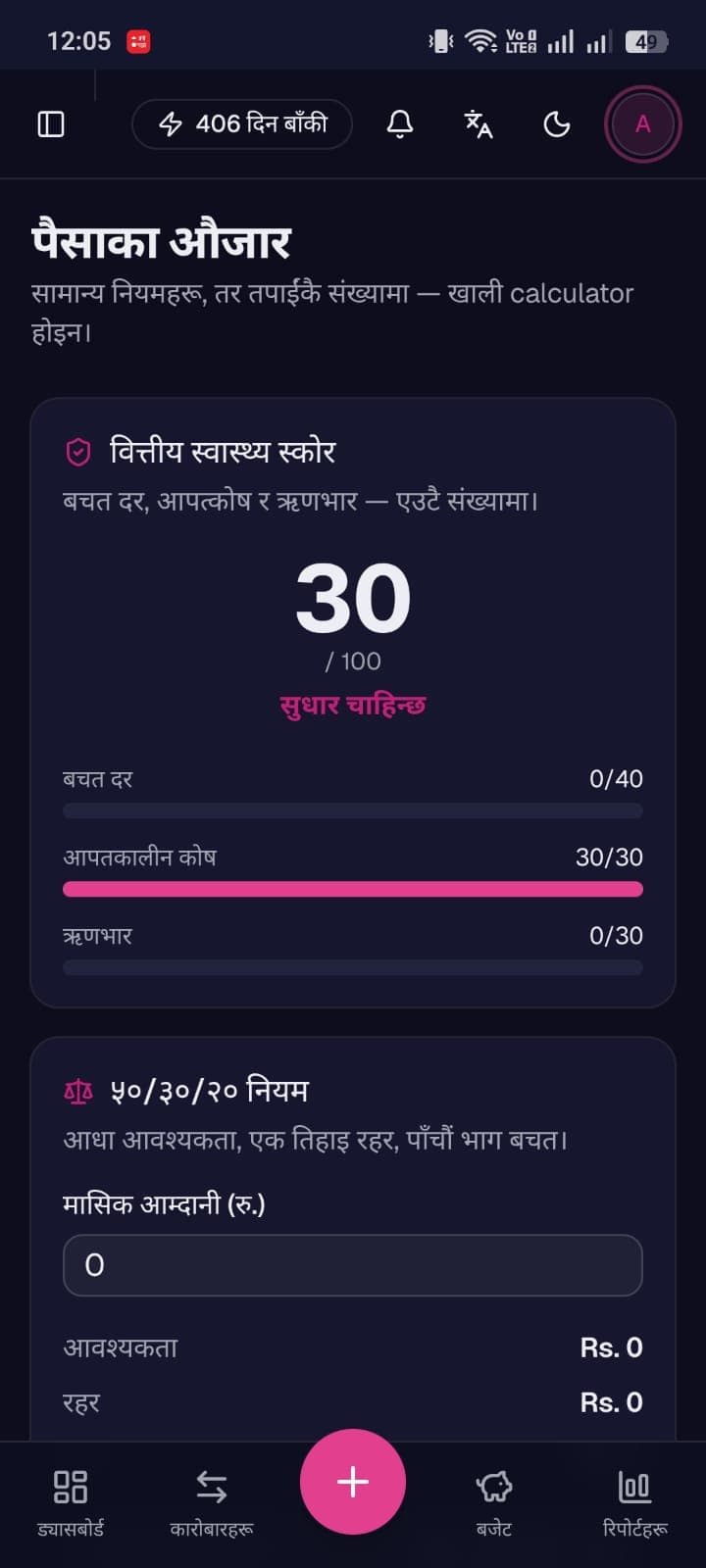
Aafno Hisab has an emergency fund planner that uses your own recorded spending rather than a guess: it shows how many months you are covered for, how far you are from your target, and how long the rest will take at the rate you are currently saving.
Because it counts your actual expenses, the number changes as your life does, and watching "1.8 months" become "3.2 months" is a surprisingly effective reason to keep saving.
The short version
- Divide your savings by your monthly expenses, not your income
- Aim for three to six months; in Nepal, closer to six
- On Rs. 39,000 of monthly spending that is Rs. 1.17 lakh to Rs. 2.34 lakh
- The jump from zero to one month covered is the biggest risk reduction there is
- Keep one month liquid, the rest in a laddered fixed deposit
- Build the fund before you invest
Related: How much should you save every month? · Fixed deposit after TDS