How to Make a Monthly Budget in Nepal (With Real Numbers)
7 min read · Published 31 Aug 2026 (15 Bhadra 2083)
Updated 29 Sept 2026 (13 Aswin 2083)
Ask ten people in Kathmandu where their salary went last month and nine will say the same thing: thaha bhayena, no idea. Not because they wasted it. Because nobody wrote it down.
This is a budget you can actually build tonight, using a real Nepali salary and real Kathmandu prices. No apps required to read it, though it takes about two minutes a day to keep once you start.
Why most budgeting advice fails in Nepal
Open any budgeting guide and you will find the same three assumptions:
- Your salary arrives on the 1st
- Your spending is on card, so there is a statement
- Your year has no month where you spend three times as much
None of these are true here. Salary lands somewhere around the end of the Nepali month. Most spending is cash, the tarkari pasal, the tempo, the chiya. And then Dashain arrives and eats a month and a half of income in three weeks.
So a budget for Nepal has to start somewhere else: with what actually reaches your hand.
Step 1: Find your real monthly income
Not the number on the offer letter. The number that reaches your bank.
Take your gross salary and subtract:
- Social Security Fund or provident fund contribution
- Income tax deducted at source
- Any staff loan instalment your office already cuts
What is left is what you budget with. If you also earn from tuition, freelance work, rent or remittance, add the amount you can rely on, not the good months.
Rule: budget with the money you are sure about. Anything extra is a bonus, and bonuses should go to savings before they get noticed.
Step 2: Separate the bills you cannot argue with
These are the ones that arrive whether you think about them or not.
Add yours up. This number matters more than any other in the budget, because it is the part you cannot fix this month even if you want to.
Step 3: The 50/30/20 rule, adjusted for Nepal
The classic rule says: 50% needs, 30% wants, 20% savings. It is a good frame, but it was written for a place where rent is the biggest line and food is small. Here food and rent both bite.
Use it as a target, not a law:
- 50% needs: rent, bills, dal-bhat, transport, EMI, school fees
- 30% wants: eating out, clothes, subscriptions, trips, gifts
- 20% savings: emergency fund first, then goals
If your needs are at 65%, you have not failed. You have found out that your rent or your EMI is too big for your income, which is a useful thing to know and a hard thing to change quickly.
A real example: Rs. 45,000 a month
Here is a budget that a lot of people in Kathmandu will recognise.
Needs at 71%, savings at 13%. Below the target, but not a disaster, and now you can see exactly which two lines to work on. The bike EMI ends eventually. The rent will not fall, but the next room might be cheaper.
That is the whole point of a budget: not to feel guilty, but to know which number to push on.
Step 4: Plan for Dashain in Shrawan
The single biggest hole in Nepali household budgets is festival spending, and it is entirely predictable.
Add up last year's Dashain and Tihar: new clothes, gifts, travel to the village, animals, dakshina. For most families it lands somewhere between one and two months of income.
Divide it by twelve and treat it as a fixed cost. Setting aside Rs. 4,000 a month from Shrawan means Dashain does not arrive as a shock, and you do not end up borrowing for it, which is how a lot of people first end up paying interest to a sahakari.
Step 5: Find the leaks
After one month of writing things down, almost everyone finds the same three:
- Chiya and khaja. Rs. 60, three times a day, is Rs. 5,400 a month. Nobody feels it happening.
- Subscriptions you forgot. Two streaming services, an unused gym, a cloud plan.
- Small online orders. Individually invisible, collectively a rent payment.
You do not have to stop any of them. You have to see them, then decide.
How to keep the budget without hating it
Writing every expense in a copy works for about eleven days. What works longer is making the recording take ten seconds and happen at the moment of spending.
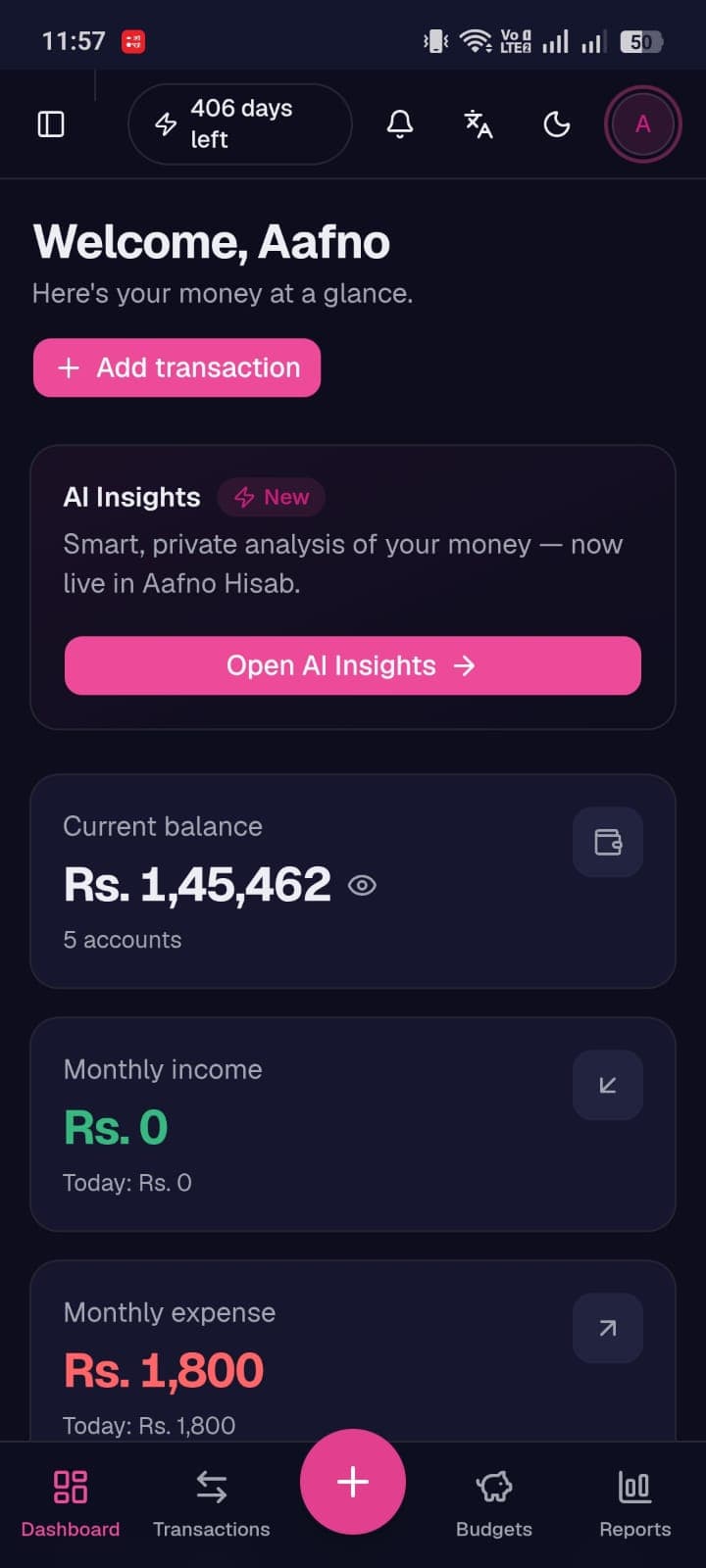
That is what Aafno Hisab is built for. It is free to track income and expenses, it shows amounts the way we read them, Rs. 1,45,000, not $1,450, and it uses the Bikram Sambat calendar, so "this month" means Bhadra, not August.
Three things it does that a copy cannot:
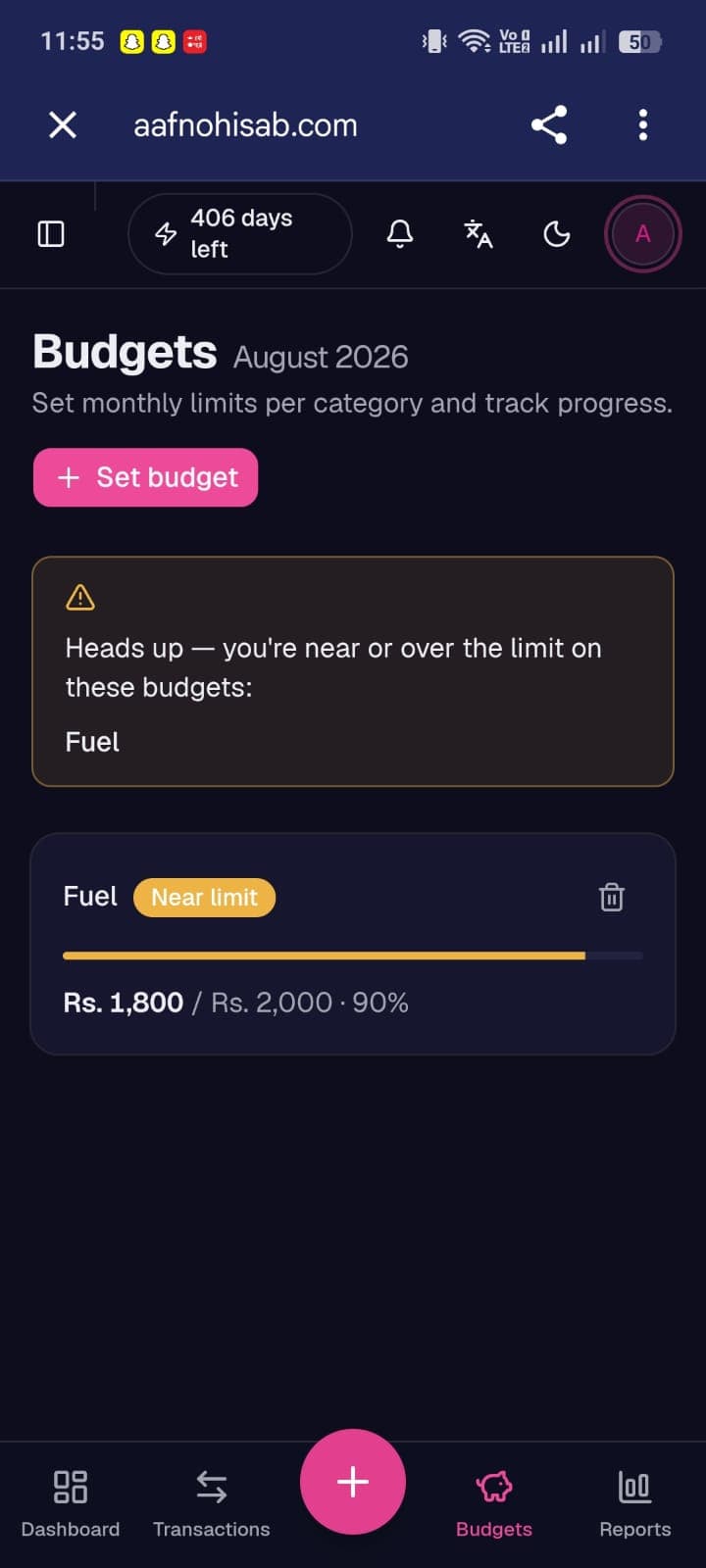
- Budgets warn you at 90%, before you cross the limit, not after
- It works offline: record the tempo fare on the way home, it syncs later
- Money tools check the 50/30/20 split against your real numbers instead of asking you to do the arithmetic
What to do tonight
- Write down your take-home salary
- List your fixed costs, the ones that arrive on their own
- Subtract. What is left is your real spending money
- Divide last year's Dashain spending by twelve and put that aside
- For one month, record every expense on the day it happens
The fifth step is the only hard one, and it is the one that changes everything. A month of honest records tells you more about your money than a year of good intentions.
Next: if part of your monthly outgoing is a loan, read Bank EMI vs Sahakari Loan, the difference between the two is bigger than most people realise. And if money you lent to friends never seems to come back, that has a fix too.