Bank EMI vs Sahakari Loan: Which One Actually Costs You More?
8 min read · Published 31 Aug 2026 (15 Bhadra 2083)
Updated 3 Sept 2026 (18 Bhadra 2083)
Two people borrow Rs. 3,00,000 on the same day.
One goes to a bank and takes a two-year loan at 14%. Every month, Rs. 14,403 leaves the account. It hurts.
The other borrows from a sahakari at 18%, interest only. Every month, Rs. 4,500. It barely registers.
Two years later, the first person owes nothing. The second still owes Rs. 3,00,000, and has paid Rs. 108,000 in interest to get there. The one that felt light cost more than twice as much.
This is the single most expensive misunderstanding in Nepali household finance, and it comes from the fact that the two loans work in completely different ways.
How a bank EMI actually works
An EMI is one fixed amount that covers both interest and principal. Every month, part of it pays the interest that has built up, and whatever is left goes to reducing what you owe.
Because the balance shrinks, next month's interest is smaller, so more of the same EMI goes to principal. Near the end, almost the whole instalment is principal.
For Rs. 3,00,000 at 14% over 24 months:
| Amount |
|---|
One more detail Nepali banks add: interest is usually calculated on the day count: outstanding × rate × days ÷ 365, so a 31-day month costs slightly more than a 30-day one. That is why your bank's sheet and a generic online calculator rarely match to the rupee.
How a sahakari or relative loan works
Most informal lending here does not amortize at all. You pay the interest each month and return the whole principal at the end of the agreed term.
For the same Rs. 3,00,000 at 18%, interest only, over 24 months:
| Amount | |
|---|---|
| Monthly interest | Rs. 4,500 |
| Total interest over 2 years | Rs. 1,08,000 |
| Owed at the end |
Notice what is missing: nothing you paid reduced the loan. After 24 faithful payments, the debt is exactly the size it was on day one.
Side by side
The rate difference is 4 percentage points. The cost difference is Rs. 62,328, and a debt that is still standing.
So why does anyone take the second one?
Because monthly cash matters more than total cost when money is tight, and because the second loan is often the only one available.
There are honest reasons to borrow interest-only:
- Your monthly income cannot carry an EMI. Rs. 4,500 is possible; Rs. 14,403 is not. A loan you can service is better than a default.
- The money is bridging a known event. Land sale in six months, a payment due after harvest, a contract settling. You will repay the principal in one piece.
- No bank will lend to you. No collateral, no salary slip, no credit history. The sahakari or the relative is the whole market.
- Money the same afternoon, no file, no guarantor hunt.
None of those are mistakes. The mistake is taking an interest-only loan for something that will take years to repay, and never making a plan for the principal.
The trap: rolling it over
Here is how a Rs. 3,00,000 loan becomes a ten-year problem.
The term ends. The principal is due. You do not have Rs. 3,00,000, you have been paying Rs. 4,500 a month for two years and saving nothing. So you agree to extend for another two years.
Now the same debt has cost Rs. 2,16,000 in interest and the balance has still not moved. Do it once more and you have paid Rs. 3,24,000, more than the loan itself, and you still owe every rupee.
If you take an interest-only loan, decide on day one where the principal will come from. Write the date down. Save towards it monthly, as if it were a second EMI.
Which should you choose?
| Your situation | Better fit |
|---|
And one rule for both: if you can pay a little extra, pay it. On an EMI, every extra rupee goes straight to principal and shortens the loan. On an interest-only loan, extra payments are the only thing that will ever reduce it.
Track both properly
Most finance apps only understand bank EMIs. If you enter a sahakari loan as an amortizing one, the app will happily tell you the debt is shrinking when it is not.
Aafno Hisab handles both. Choose EMI and you get a bank-style amortization schedule with day-count interest and the principal-interest split for every instalment. Choose Interest only and the schedule shows each interest payment separately, with the full principal falling due at the end, where it belongs, in plain sight.
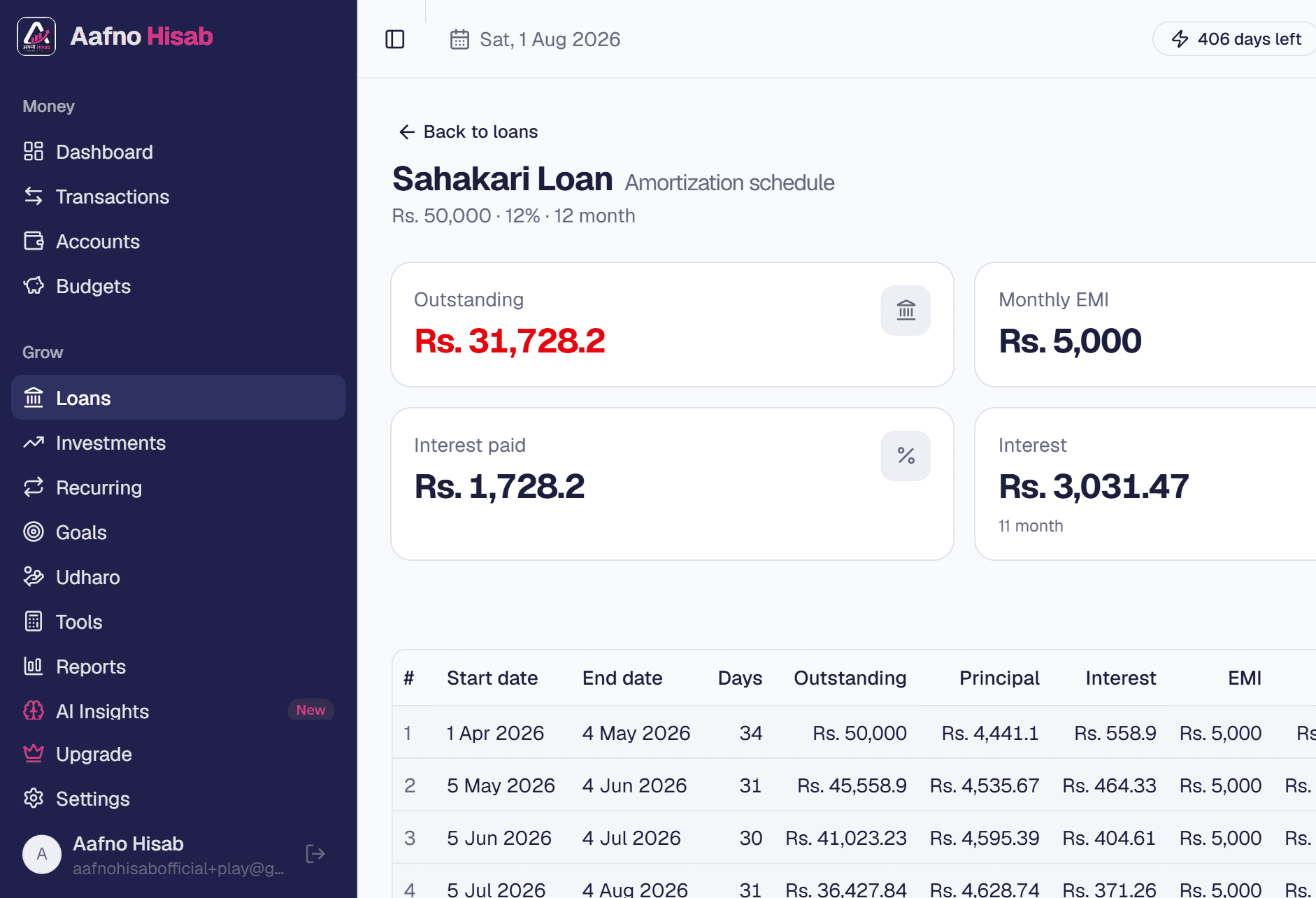
There is also a prepayment calculator that tells you what paying an extra Rs. 2,000 a month would actually save you, usually more than people expect.
The short version
- A bank EMI reduces the debt every month. An interest-only loan does not.
- A lower monthly payment is not a cheaper loan.
- On Rs. 3,00,000 over two years, the "cheap" option cost Rs. 62,328 more and left the whole debt standing.
- If you borrow interest-only, fix the date and the source for the principal on day one.
Related: How to make a monthly budget in Nepal, an EMI you can carry starts with knowing what your month actually looks like.