How Much Should You Save Every Month? The 50/30/20 Rule in Nepali Rupees
7 min read · Published 31 Aug 2026 (15 Bhadra 2083)
Updated 29 Sept 2026 (13 Aswin 2083)
"Save 20% of your income" is the most repeated piece of money advice in the world, and the least useful one in Nepal.
On a Rs. 45,000 salary it means putting away Rs. 9,000 every month. If your room costs Rs. 10,000 and food costs Rs. 11,000, you already know how that goes. So people hear the rule, fail it once, and stop reading.
The rule is still worth having. It just needs to be used the way it was meant to be, as a measuring stick, not a pass mark.
What the rule actually says
Split your take-home income three ways:
- 50% needs: rent, food, transport, bills, EMI, school fees
- 30% wants: eating out, clothes, outings, subscriptions
- 20% savings: emergency fund, goals, investment
The useful part is not the numbers. It is that it forces you to separate needs from wants, which is the distinction almost nobody makes when the salary lands.
Why 20% is hard here
In the places this rule was written, rent is the giant line and food is small. Here both are large at once, and a third line, supporting family, barely exists in the original version.
Three things push Nepali households over 50% on needs:
- Food is a real share of income. Rs. 10,000–12,000 for one person eating simply is normal.
- Festival spending is not optional. Dashain and Tihar together often cost more than a month's salary.
- Money goes to other people. Parents, a sibling's fees, a relative's hospital bill. It is a need, and no budgeting template has a line for it.
So do not measure yourself against 50/30/20 and conclude you are bad with money. Measure yourself against it and find out which line is oversized.
What it looks like at three salaries
Rs. 25,000 a month
Nowhere near 20%, and that is fine. At this income the goal is not a percentage, it is the habit plus one month of expenses in the bank. Rs. 2,500 a month gets you there in eight months. That is a genuine achievement.
Rs. 45,000 a month
The most common shape in Kathmandu. Needs are heavy because rent and food are heavy. The lever here is usually a specific line, a bike EMI that ends, or a room you will move out of, rather than general discipline.
Rs. 90,000 a month
Above the target, and this is where the rule starts working as designed. Needs do not double when income doubles, rent goes up a bit, food barely moves. The risk at this level is that wants quietly expand to fill the gap.
The pattern worth noticing
Look at the needs column across the three: Rs. 19,000, Rs. 32,000, Rs. 45,000. Income rose 3.6×; needs rose 2.4×.
That gap is where saving comes from. The trick is not earning more, it is not letting your needs grow at the same speed as your income. The first raise after which your rent does not change is the raise that builds your emergency fund.
What to save for, in order
Do these one at a time. Skipping ahead is how people end up selling an investment at a bad moment to pay a hospital bill.
1. One month of expenses. The first goal, whatever your income. It turns an emergency into an inconvenience.
2. Three to six months of expenses. The real emergency fund. On Rs. 39,000 of monthly spending, six months is Rs. 2,34,000, which sounds impossible until you notice that at Rs. 6,000 a month it is a three-year project, and three years pass anyway.
3. Known upcoming costs. Dashain, a wedding, a laptop, insurance renewal. Divide by the number of months until it happens and save that much. This is the single change that keeps people out of interest-only borrowing, which is more expensive than it looks.
4. Then invest. Fixed deposit, gold, shares, but only with money you will not need soon.
If you cannot save anything at all
Then the budget is telling you something real, and it is worth listening rather than feeling bad.
- Needs above 75%? One line is too big, usually rent or an EMI. It will not be fixed this month, but it can be fixed at the next renewal or when the loan ends.
- Wants above 30%? This one is fixable this month, and it is almost always three or four small recurring things rather than one big indulgence.
- Income genuinely too low? Then the honest answer is that the next move is income, not budgeting. But keep tracking anyway, you will need to know where it went when the income does rise.
Let the arithmetic happen by itself
Working this out once on paper is useful. Working it out every month is a chore nobody keeps up.
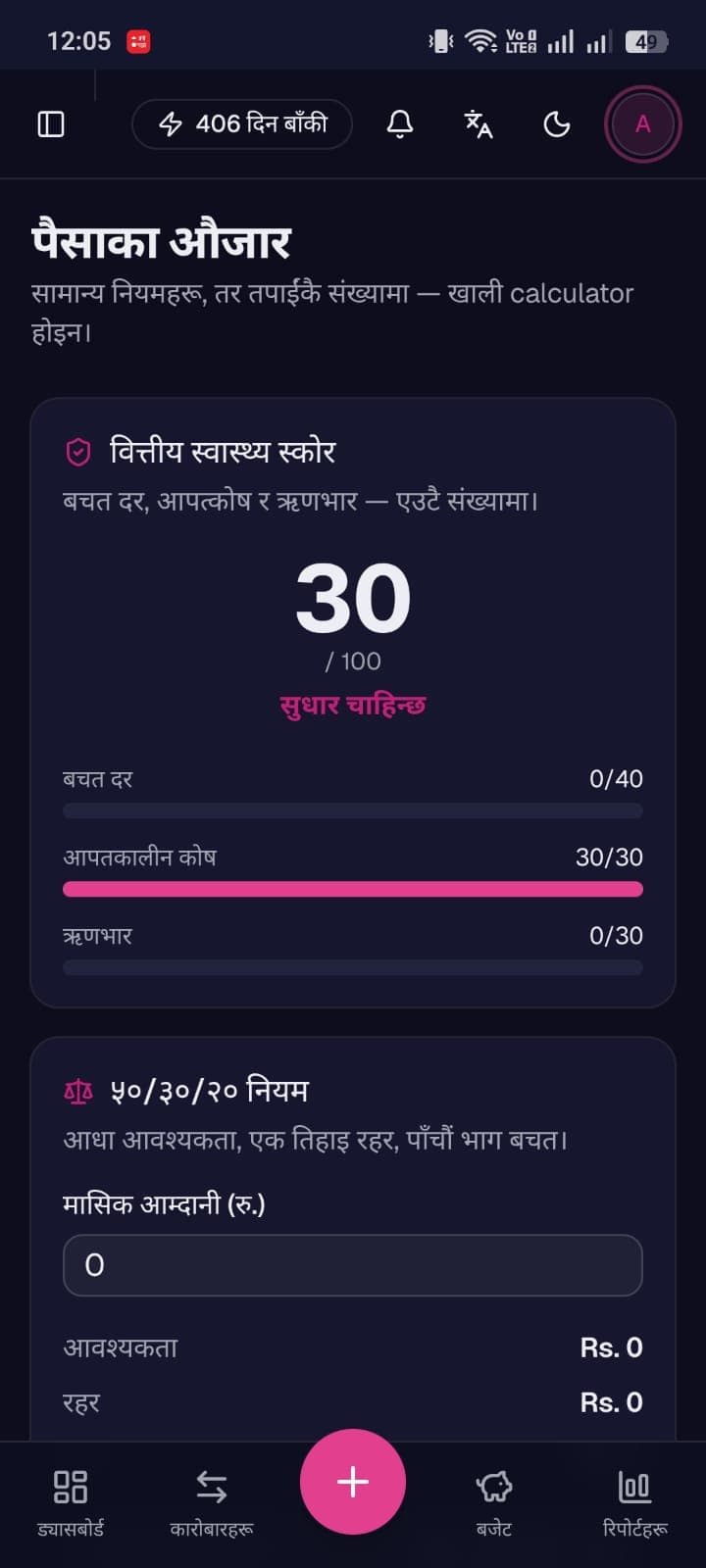
Aafno Hisab has the 50/30/20 rule as one of its money tools, running on your own recorded numbers rather than blank boxes. It shows what you actually saved this month, the percentage, and whether you are on track, and next to it, an emergency fund planner that tells you how many months you are covered for and how long the rest will take at your current pace.
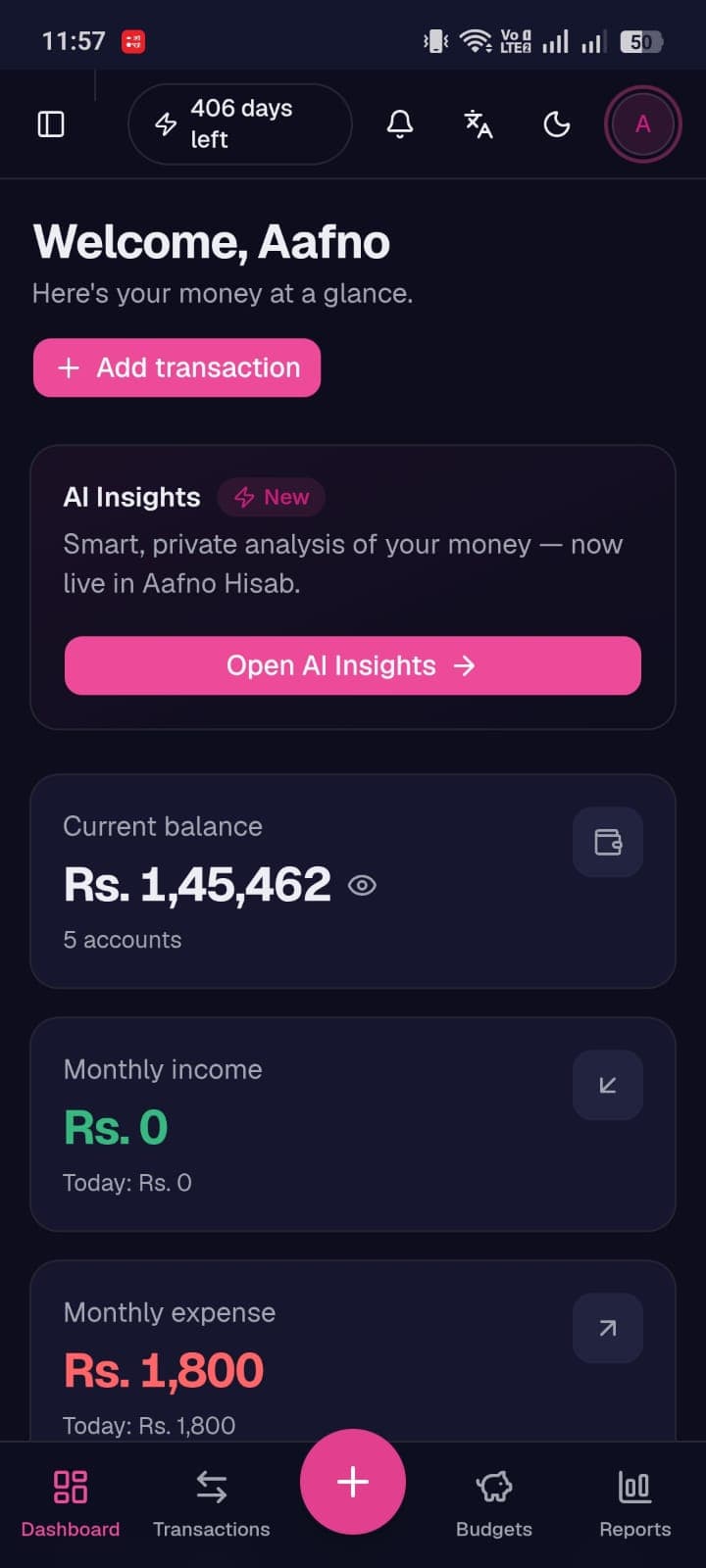
Tracking income and expenses is free, so you can see your real split before deciding whether any of this needs changing.
The short version
- 50/30/20 is a measuring stick, not a pass mark
- On most Nepali salaries, needs land at 70–76%, and that is normal
- At low incomes, aim for the habit and one month saved, not a percentage
- Keep your needs from growing with your income, that gap is your savings
- Save in order: one month, then three to six, then known costs, then invest
Related: How to make a monthly budget in Nepal · Fixed deposit after TDS