That adds to Rs. 12,00,000: an average of a lakh a month, which is a good income in Kathmandu by any measure.
And yet this person felt broke three times that year, borrowed once, and spent the two-forty month in a way they could not fully account for afterwards. Nothing was wrong with the income. Everything was wrong with the shape of it.
This is about fixing the shape first, because the tax question is much easier to answer once the money stops moving around.
The problem is not the dry months. It is the good ones.
Everyone thinks the zero months are the problem. They are not, they are predictable and survivable.
The damage is done in the Rs. 2,40,000 month. Money that arrives in a lump gets spent like a lump: the laptop, the trip, the thing that had been waiting. It feels earned, because it was. But that Rs. 2,40,000 was never one month's income, it was the funding for the two zero months that follow, and it got spent before it knew that.
A freelancer's real income is not what arrived this month. It is the year divided by twelve. Everything below follows from that one sentence.
Pay yourself a salary
This is the fix, and it is the only one that reliably works.
1. Open a second account. All client money lands there. Call it the business account even if you are not registered as a business. You do not spend from it. Ever.
2. Decide your salary. Take last year's total, or a conservative estimate of this year's, and pay yourself a fixed amount into your personal account on a fixed date every month.
On Rs. 12,00,000 a year, the arithmetic looks like this:
Amount
Year's income
Rs. 12,00,000
Average month
Rs. 1,00,000
Salary you pay yourself
Rs. 60,000 a month
Paid out over the year
Rs. 7,20,000
Left in the business account
Rs. 4,80,000
3. Live on the salary. Your household budget is now a Rs. 60,000 salary, which is an ordinary problem with ordinary solutions. The dry months stop being events.
4. The Rs. 4,80,000 that stays behind is not spare money. It is tax, it is your buffer, it is the pension nobody is paying for you, and it is the equipment fund. Section by section below.
Sixty percent is a reasonable starting ratio for most Nepali freelancers. Take less if your income is volatile or new. The number you must not do is take everything and hope.
What the 40% is actually for
An employee has costs paid on their behalf that they never see. You have the same costs and no one is paying them. This is where that money goes:
Tax. Set aside a share of every payment as it arrives, in a separate place. The exact rate depends on how you are registered and how much you earn, see below, but the discipline of moving it on the day money lands is what stops the annual bill being a crisis.
A buffer, and a bigger one than employees need. A salaried person is usually advised to hold a few months of expenses. A freelancer with three zero months in a year needs more, six months is the honest target, and it is the difference between turning down bad work and having to accept it.
Retirement, which nobody is funding for you. A salaried employee has 20% of basic going into provident fund, or 31% into SSF, plus gratuity, all of it invisible on their payslip. You have none of that. If you put nothing aside, you are not earning more than an employee on a similar figure. You are earning less, with better hours.
Insurance. Health cover, and life cover if anyone depends on you. Employees on SSF have some of this; you have exactly what you buy.
Equipment and dry-month cover. Laptops die on the worst possible day.
A freelancer on Rs. 12,00,000 who saves none of this is not doing better than a salaried colleague on Rs. 8,40,000. That comparison is worth doing honestly once.
Tax, PAN and being registered
This section is deliberately about shape rather than numbers, because thresholds and rates change with each budget and the wrong number here would cost you more than no number.
Get a PAN. If you earn business income in Nepal you need one. It is free, the process is online through the Inland Revenue Department, and it is the thing that makes everything else, bank accounts, invoices, deductible expenses, straightforward. Freelancers put this off for years and it never becomes easier.
You are taxed on worldwide income. If you are resident in Nepal, income from a client in Australia is taxable here. Money arriving through a payment platform rather than a bank does not change that.
There are simpler regimes for small turnover. Nepal has presumptive and turnover-based options for small businesses that are far less work than full accounts. Whether you qualify depends on your turnover and your line of work.
VAT has a threshold. Above a certain annual turnover, VAT registration becomes compulsory, and the threshold is different for services than for goods. Services exported abroad are treated differently from services sold locally. Find out where you stand before you cross it, not after.
Business expenses reduce taxable income: but only if they are recorded and documented. Your share of internet and electricity, software subscriptions, equipment, professional fees. The freelancer who keeps receipts pays materially less tax than the one who does not, on identical income.
Do this once: an hour with an accountant, early, costs a few thousand rupees and tells you exactly which regime you fall under. Doing it at the point where you are already behind costs considerably more. Verify current rules at ird.gov.np.
Getting paid from abroad
Most Nepali freelancers with foreign clients hit the same practical wall, and the rules on inward remittance and foreign currency accounts are set by Nepal Rastra Bank and change from time to time. So the durable advice is about paperwork rather than about which service to use.
Ask your own bank what they support for inward remittance for services. Answers differ between banks, and it is a five-minute question.
Keep the paperwork for every payment: the invoice you sent, the contract or written scope, and the bank's advice or credit note when the money lands. This is what makes the income explainable, to the bank, and later to the tax office.
Record the rupee amount that actually reached your account, not the dollar figure you invoiced. Between the exchange rate and the fees, the two are never the same, and the second one is the one that is real.
Invoice in writing, even for a friendly client. A numbered invoice with a date is what turns a bank transfer into documented business income.
Do not route business income through a friend's account. It is common, and it makes the money undocumentable, which is a much worse problem than tax.
The five-minute monthly routine
Move the tax share out of the business account, the day money arrives.
Pay yourself the salary, on the same date every month.
Record every payment received: client, invoice number, rupees actually credited.
Record business expenses with receipts, separately from personal ones.
Once a quarter, check the salary is still right. If the business account keeps growing, raise it. If it is shrinking, lower it now rather than in the month it runs out.
That last one is the discipline that makes this survive a bad year. A salary is a decision you revisit on purpose, not a number you exceed quietly.
The short version
Your income is the year divided by twelve, not what arrived this month.
Two accounts. Client money lands in one; a fixed salary moves to the other.
Start around 60% as salary. The rest is not spare money.
The 40% funds tax, a six-month buffer, retirement, insurance and equipment: all the things an employer pays invisibly.
Get a PAN early. Keep receipts; they are money.
Keep the invoice and the bank advice for every foreign payment, and record the rupees that landed.
Spend one hour with an accountant before you need one.
The good months are not a bonus. They are the funding for the bad ones, which have not happened yet.
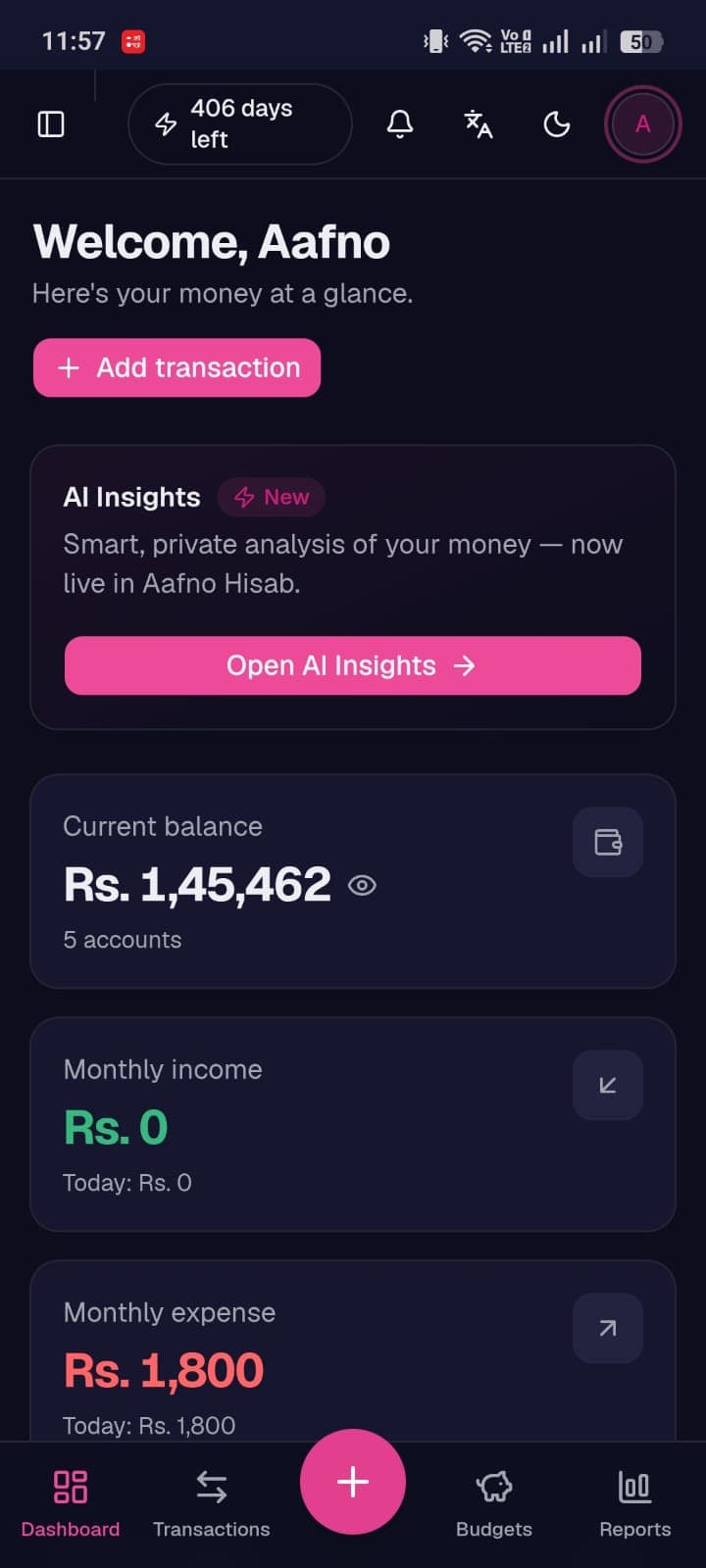
Aafno Hisab is built for exactly this shape of income: separate accounts for business and personal money, transactions you can enter in four seconds on a phone, and reports that export to Excel or PDF when the accountant asks. It works offline, in Nepali or English, on the Bikram Sambat calendar. See what it does.
Common questions
How should a freelancer in Nepal manage irregular income?
Treat your income as the year divided by twelve rather than whatever arrived this month. Keep two accounts: client money lands in one, and a fixed salary moves to the other on the same date monthly. Around 60% of average income is a reasonable starting salary, leaving the rest for tax, buffer, retirement, insurance and equipment.
Do freelancers in Nepal have to pay income tax on foreign clients?
Yes. A resident of Nepal is taxed on worldwide income, so payment from a client abroad is taxable here, and receiving it through a payment platform rather than a bank does not change that. Keep the invoice, the contract or written scope, and the bank's advice for every payment, and record the rupees that actually landed rather than the dollars invoiced.
Does a freelancer need a PAN in Nepal?
Yes, earning business income in Nepal requires one, registration is free through the Inland Revenue Department, and it is what makes invoicing, bank arrangements and deductible expenses straightforward. Nepal also has simpler presumptive and turnover-based regimes for small businesses, and which applies depends on your turnover and line of work.
How much should a freelancer save for tax and retirement?
Move the tax share out of the business account on the day money arrives rather than at year end. Beyond tax, a freelancer needs a larger buffer than a salaried person, six months rather than three, plus retirement savings that no employer is making, and insurance. A salaried colleague has roughly 28% of basic going into retirement invisibly; a freelancer has nothing unless they arrange it.
How do I receive payments from foreign clients in Nepal?
Ask your own bank what it supports for inward remittance for services, since answers differ between banks and the rules are set by Nepal Rastra Bank. Invoice in writing even for friendly clients, keep the bank's advice or credit note for every payment, and never route business income through someone else's account, that makes the income undocumentable, which is a worse problem than tax.
Share this article
Loans & EMI
Bike & Car Loan in Nepal: Down Payment, EMI, Hidden Costs