How to Save on a Rs 25,000 Salary in Kathmandu · Aafno Hisab
Saving
How to Save on a Rs 25,000 Salary in Kathmandu
9 min read · Published on 22 September 2026
Budgeting advice written for people on a lakh a month is not merely unhelpful at Rs. 25,000, it is insulting. Cut back on dining out. You are not dining out. Cancel unused subscriptions. There are none.
So here is the version for the salary that actually exists, in the city that actually charges what it charges.
Not comfortably, and not in every month. But it can, and the reason most people at this salary save nothing is not the rent. It is roughly Rs. 8,000 a month that leaves in pieces so small nobody counts them.
The short answer: a Rs. 25,000 salary in Kathmandu can save around Rs. 5,500 a month.
A Rs 25,000 budget that survives Kathmandu
Single person, sharing a flat, cooking at home, using public transport:
Per month
Room, single, in a shared flat
Rs. 6,500
Food, cooking at home
Rs. 7,000
Transport, bus and tempo
Rs. 2,000
Phone and internet
Rs. 1,200
Electricity, water, gas share
Rs. 1,300
Soap, haircut, clothes, everything else
Rs. 1,500
Total spent
Rs. 19,500
Left to save
Rs. 5,500
That is 22% of the salary, which is the number the advice books ask for and which everybody assumes is impossible at this income.
Three honest caveats before you tell me your rent is higher.
The room number assumes sharing. A single room to yourself in a decent Kathmandu neighbourhood is Rs. 10,000 and up, and it is the single largest decision on this list. Sharing is what makes the rest of the budget work. There is no clever technique that substitutes for it.
Cooking is not optional at this salary. Rs. 7,000 of groceries feeds one person well. The same money buys about twenty-three restaurant meals, a week and a half.
This budget has no festival, no illness and no trip home. Which is why it saves 22% rather than 10%, the extra is not spare, it is what absorbs the months that are not ordinary.
Where the money actually goes
Now the part that decides whether you save anything, and it is not in the table above.
These are the expenses that never feel like expenses:
Per month
Daily chiya and a snack, Rs. 60
Rs. 1,800
Cigarettes, one packet a week
Rs. 1,600
Eating out twice a week
Rs. 2,800
Data top-ups on top of the pack
Rs. 600
Impulse online orders
Rs. 1,200
Total
Rs. 8,000
Rs. 8,000. Thirty-two percent of a Rs. 25,000 salary.
Read that against the Rs. 5,500 the budget saves. The leaks are larger than the savings: which means the person on Rs. 25,000 who saves nothing is not failing to earn enough. They are losing more than a fifth of their income sixty rupees at a time.
Not every item applies to everyone, and nobody should cut all of them. That is not the point. The point is that these are the only numbers on this page you can change this week. Your rent is fixed until your lease ends. Your chiya is a decision you make tomorrow morning.
Pick two. Halving the chiya habit and cutting one of the two weekly meals out recovers about Rs. 2,300 a month, Rs. 27,600 a year, on a salary of three lakh.
What Rs 5,500 a month actually becomes
The reason to bother, because at this income the saving feels too small to matter.
At 8% a year:
After 1 year
Rs. 68,475
After 3 years
Rs. 2,22,946
After 5 years
Rs. 4,04,123
After 10 years
Rs. 10,06,203
Ten lakh. From Rs. 5,500 a month, on a Rs. 25,000 salary, assuming, pessimistically, that your salary never rises.
The first year is the discouraging one: Rs. 68,000 for twelve months of discipline does not feel like much. Year seven is where it stops feeling like saving and starts feeling like having money. Almost everyone who quits, quits in year one.
The order to do things in
Do not do all of this at once. In this order:
1. One month of expenses first, Rs. 19,500. Before investing anything, before any scheme. This is the difference between a flat tyre being an annoyance and being the reason you borrow at a rate that ruins you. On Rs. 5,500 a month it takes about four months.
2. Then three months, around Rs. 60,000.This is your actual security, and at this income it matters far more than any investment return, because you have no other cushion at all.
3. Then start growing it. A fixed deposit is the honest first step, modest, guaranteed, and boring. Once the cushion is solid and the horizon is long, Rs. 1,000 a month into a SIP is where small money has historically grown fastest.
4. Only then think about a loan for anything. Not before.
Most people at this income do these in reverse: they join a scheme, then have no cushion, then borrow when something breaks, then lose the scheme. The order is the strategy.
Five things that work at this income
Withdraw your week's cash on Sunday, and use it. Cash you can see runs out visibly; a wallet balance does not. The single most effective control available at this salary costs nothing.
Move the savings the day you are paid. Not what is left at month end, there is never anything left at month end. Rs. 5,500 out on payday, into a separate account, before anything else moves.
Cook in batches, twice a week. The Rs. 7,000 food line only holds if cooking is a habit rather than a decision made at 8pm while tired. That is when Rs. 350 leaves instead of Rs. 90.
Share the biggest bills. Room, internet, gas. Splitting one of these is worth more than a month of careful spending.
Write down every expense for one month. Only one. Almost nobody at this income knows their real numbers, and the list above will not match yours. Yours will have something on it that surprises you, and that surprise is worth more than any advice on this page.
Common questions
Can you save money on a Rs 25,000 salary in Kathmandu?
Yes, around Rs. 5,500 a month, or 22% of the salary, on a budget of Rs. 6,500 rent in a shared flat, Rs. 7,000 food cooking at home, Rs. 2,000 transport and about Rs. 4,000 for utilities, phone and everything else. Sharing accommodation and cooking at home are what make it possible; without both, the arithmetic does not work at this income.
What is a realistic monthly budget for one person in Kathmandu?
For a single person living simply: about Rs. 6,500 for a room in a shared flat, Rs. 7,000 for groceries, Rs. 2,000 for bus and tempo, Rs. 1,200 for phone and internet, Rs. 1,300 for utilities and Rs. 1,500 for everything else, roughly Rs. 19,500 a month. A room to yourself adds Rs. 4,000 or more and is the largest single variable.
Where does money go on a low salary in Nepal?
Usually not the big bills. Daily chiya and snacks at Rs. 60 come to Rs. 1,800 a month, a packet of cigarettes a week is Rs. 1,600, eating out twice a week is Rs. 2,800, data top-ups Rs. 600 and impulse orders Rs. 1,200, about Rs. 8,000, or 32% of a Rs. 25,000 salary. These are larger than what most people at this income manage to save.
How much should I save from a Rs 25,000 salary?
Aim for Rs. 5,000 to Rs. 5,500 a month, moved on payday rather than kept back at month end. Build one month of expenses first, then three months as an emergency fund, and only then start investing. At 8%, Rs. 5,500 a month becomes about Rs. 4 lakh in five years and Rs. 10 lakh in ten, even if your salary never rises.
Should I invest or save first on a low income?
Save first. Without an emergency fund, any shock forces you to sell an investment at a bad moment or to borrow expensively, and both wipe out years of returns. Build three months of expenses in a place you can reach, then invest. At Rs. 25,000 a month the cushion is worth more than the return, because you have nothing else behind you.
The short version
A Rs. 25,000 salary in Kathmandu can save about Rs. 5,500 a month: sharing a room and cooking at home.
The leaks total about Rs. 8,000: more than the savings. That is where the money goes.
Pick two leaks, not all five. Two is a change you keep.
Move savings on payday, not at month end.
One month's expenses first, then three, then invest. In that order.
Rs. 5,500 a month for ten years is Rs. 10 lakh, assuming no raise at all.
Track everything for one month: your surprise will not be the one on this page.
Saving on a low income is not about willpower. It is about knowing where Rs. 8,000 goes, which takes one month of writing things down and then never has to be discovered again.
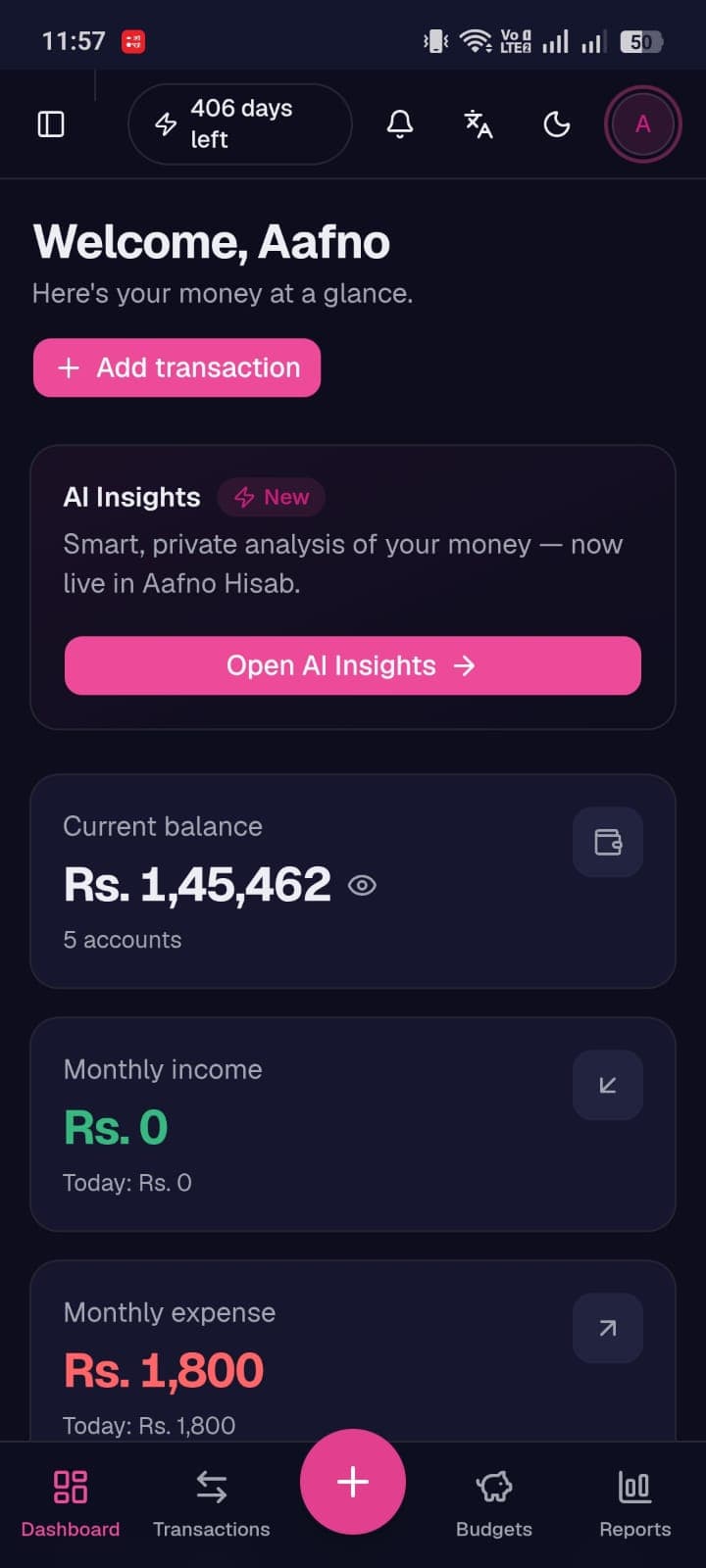
Aafno Hisab is free for exactly this, recording income and expenses, in Nepali or English, on the Bikram Sambat calendar, working offline so you can note the Rs. 60 chiya where you bought it. See what it does.
Share this article
Guides
Income Tax in Nepal: What You Pay on Rs 50,000/month