Gold vs Fixed Deposit vs Shares: Where Nepalis Put Their Money
8 min read · Published 31 Aug 2026 (15 Bhadra 2083)
Updated 7 Sept 2026 (22 Bhadra 2083)
Ask a Nepali family where the savings are and you will usually hear one of three answers: gold in the almirah, a fixed deposit at the bank, or shares in a Demat account.
There is no single winner. Each does something the other two do badly, and most of the arguments people have about them come from comparing one's strength against another's weakness.
Here is a straight look at all three, including the costs that do not appear in the pitch.
Gold
Gold is the oldest savings habit in Nepal and still the most trusted. It survives currency trouble, it needs no bank, and it doubles as something you can wear at a wedding.
What nobody mentions: if you buy jewellery, you are not buying gold at the gold price.
- Making charges typically add 10–20% on top of the metal value
- When you sell, the buyer pays for the metal only: the making charge is gone
- Impurity or a lower carat means a further deduction at resale
So a Rs. 1,00,000 necklace might contain Rs. 85,000 of gold. The price has to rise about 18% just to get you back to even.
If gold is meant to be an investment, buy tejabi gold, coins or bars rather than ornaments. If it is meant to be jewellery, that is fine, just do not count the making charge as savings.
Good at: holding value over decades, no paperwork, works in a crisis, culturally liquid, someone will always buy it. Bad at: producing income (it pays nothing while you hold it), small amounts, safe storage.
Fixed deposit
The most predictable of the three. You know the amount and the date on the day you sign.
Rs. 1,00,000 at 9% for a year comes back as about Rs. 1,08,750 after quarterly compounding and 6% TDS, the full arithmetic is here.
Good at: certainty, dates you already know, protecting money from yourself. Bad at: growth. After tax and inflation, an FD roughly preserves purchasing power rather than building it.
Shares (NEPSE)
The only one of the three that can genuinely multiply money, and the only one that can lose a large part of it.
To start you need a Demat account and a MeroShare login, which most banks and brokers will set up. Then two things matter that people underestimate:
- It takes attention. Companies, reports, sectors. Buying because a relative recommended something is not investing.
- It moves. NEPSE has had years that made people rich and years that took a third off the index. Both are normal.
Costs to remember: brokerage on each trade, capital gains tax on profit (currently 5% for individuals holding over a year, higher for shorter holdings), and tax on dividends. Rates change, check what applies before you sell.
Good at: long-term growth, dividends, small regular amounts. Bad at: money you might need next month, and anyone who checks prices daily.
Side by side
The boring answer that is usually right
Most people asking "gold or FD or shares" are asking the wrong question first. The order that works for almost everyone:
1. Emergency fund before any of them. Three to six months of expenses somewhere you can reach in a day. This is not exciting and it is the single thing that stops one hospital visit turning into a sahakari loan.
2. Clear expensive debt next. No investment reliably returns what an interest-only loan costs. Paying that off is the highest guaranteed return available to you.
3. Then split, by when you need the money.
- Needed within 2 years → fixed deposit
- Not needed for 5+ years, and you can watch it fall without selling → shares
- Long-term store of value, or you want something physical → gold, bought as metal not ornaments
4. Keep adding monthly. Regular small amounts beat waiting for the right moment, in every one of the three.
Watch all three in one place
The practical problem is not choosing, it is that gold sits in the almirah, the FD receipt is in a file, and the shares are in MeroShare, so nobody knows the total.
Aafno Hisab tracks all three together. Gold is recorded in tola at the rate you paid, with the current rate updated when you like. FDs record the maturity date and remind you before it arrives. Shares and anything else without a fixed return record their current value alone, the app will not force you to invent a percentage for something that does not have one.
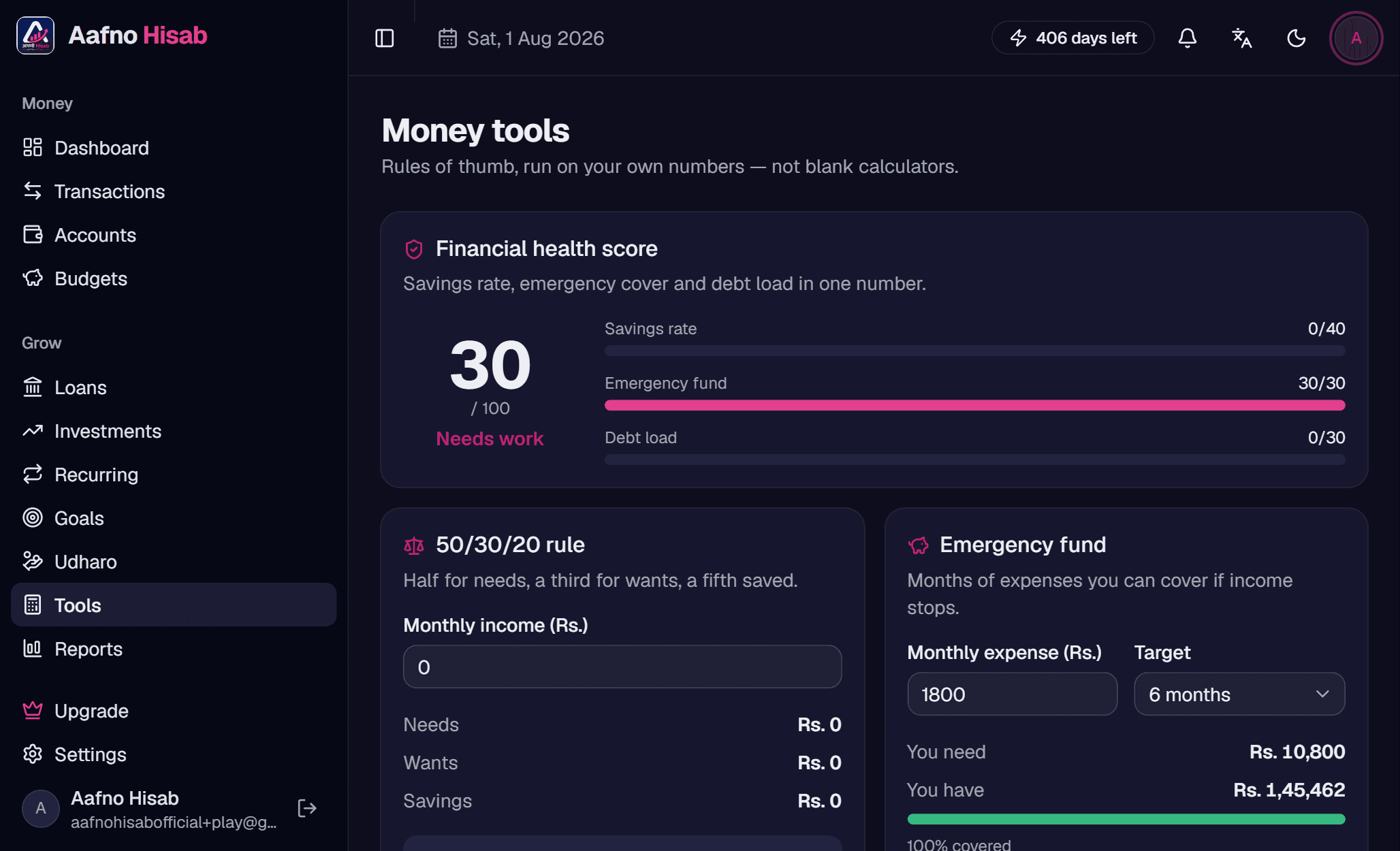
The money tools also include an FD maturity calculator, a monthly-investing projection and a gold calculator in tola, so you can test a decision before making it.
The short version
- Gold ornaments carry 10–20% making charges that vanish at resale, buy metal, not jewellery, if it is an investment
- An FD is certainty, not growth; it nets about 8.75% on a 9% headline
- Shares are the only real growth option here, and the only one that can fall hard
- Emergency fund first, expensive debt second, then split by when you need the money
This is general information, not investment advice. Rates and tax rules change, confirm current figures before you commit.
Related: Fixed deposit after TDS · How much should you save every month?